
Originally published April 8, 2016|Updated October 22, 2026
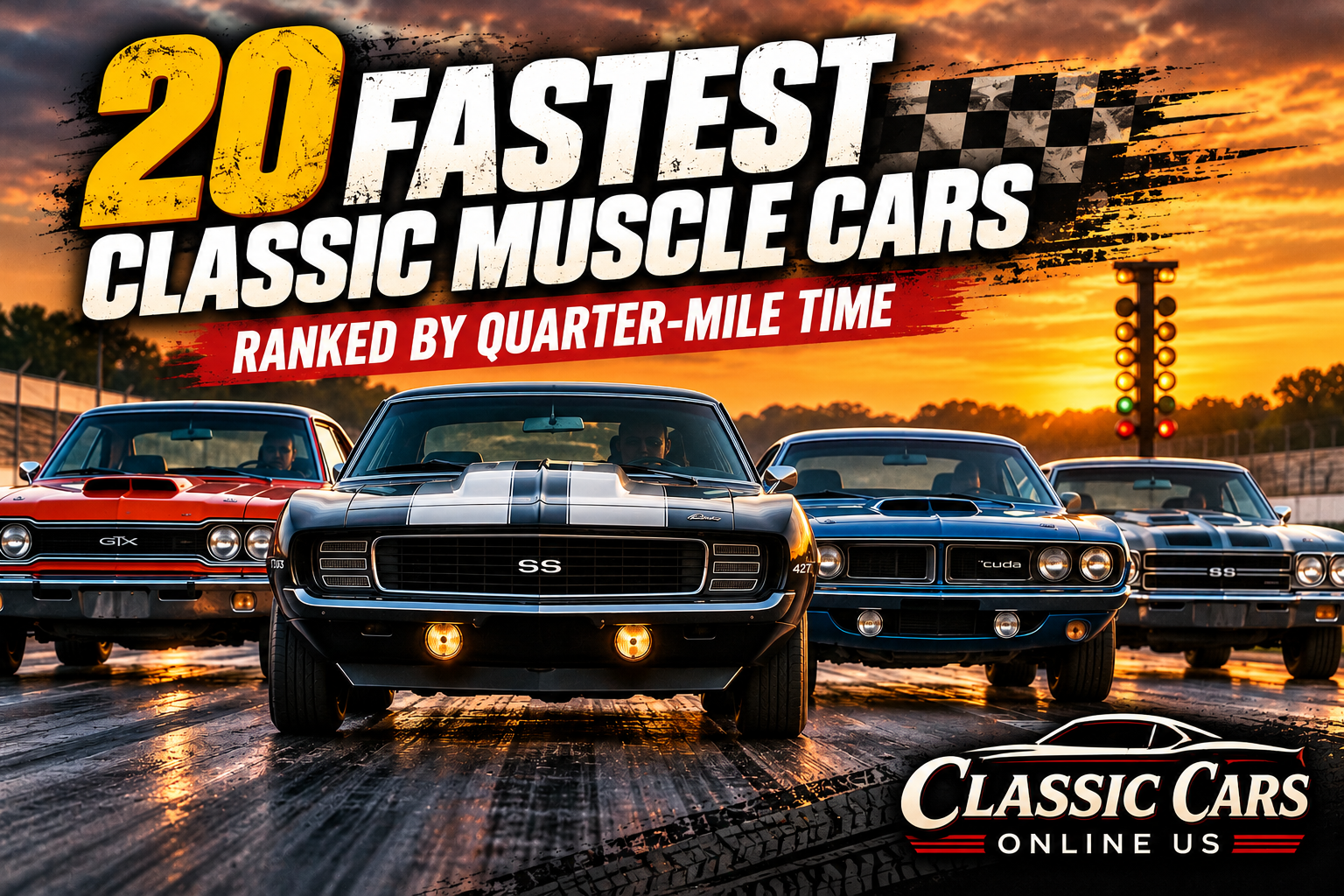
Which classic American muscle cars were the quickest? Period magazine tests recorded quarter-mile times in the low 13-second range for several of the fastest muscle cars of the late 1960s and early 1970s. One standout was the 1969 Yenko Camaro, which recorded a 12.59-second quarter mile at 108.2 mph.
But ranking these cars isn’t as simple as collecting the smallest numbers. Magazine tests differed in tires, gearing, tuning, and test preparation. Some cars were dealer specials, and some famous results came from specially prepared test vehicles.
This ranking focuses on American production-based muscle cars from roughly 1964 through 1973. It includes documented period dealer specials, such as Yenko models, but excludes two-seat sports cars such as the Shelby Cobra and Chevrolet Corvette from the main list.
How We Ranked the Fastest Muscle Cars
The quarter mile was a popular performance benchmark during the muscle-car era. A standing-start run covers 1,320 feet, or one-quarter mile.
Two measurements help tell the story in terms of the fastest muscle cars:
- Elapsed time (ET): The time required to cover the quarter mile. A lower number means a quicker run.
- Trap speed: The speed recorded near the finish line. It provides additional context about a car’s performance.
The cars below are ranked by reported elapsed time, using period magazine tests and historical reproductions that identify the original publications. These were not controlled, head-to-head tests. Differences in transmissions, gearing, tires, weather, drivers, and preparation could affect the results.
Where a test car’s exact specification or preparation remains disputed, the article identifies that uncertainty rather than presenting the number as an unquestionable factory-stock benchmark.
The 20 Fastest Classic Muscle Cars
| Rank | Car | Quarter-mile result | Period source |
|---|---|---|---|
| 1 | 1969 Yenko Camaro 427 SYC | 12.59 sec at 108.2 mph | Super Stock & Drag Illustrated, July 1969 |
| 2 | 1969 Plymouth Road Runner 440 Six Barrel | 12.91 sec at 111.8 mph | Super Stock & Drag Illustrated, June 1969 |
| 3 | 1970 Plymouth Hemi ‘Cuda | 13.10 sec at 107.12 mph | Car Craft, November 1969 |
| 4 | 1970 Chevrolet Chevelle SS 454 LS6 | 13.12 sec at 107.01 mph | Car Craft, November 1969 |
| 5 | 1969 Chevrolet Camaro COPO ZL1 | 13.16 sec at 110 mph | Hi-Performance CARS, August 1969 |
| 6 | 1968 Mercury Cougar XR-7 GT 428 Cobra Jet | 13.23 sec at 103.4 mph | Super Stock & Drag Illustrated, August 1968 |
| 7 | 1969 Yenko Chevelle 427 SYC | 13.31 sec at 108 mph | Super Stock & Drag Illustrated, August 1969 |
| 8 | 1969 Plymouth Road Runner Hemi | 13.32 sec at 107.7 mph | Rodder & Super/Stock, May 1969 |
| 9 | 1970 Plymouth Road Runner Hemi | 13.34 sec at 107.5 mph | Super Stock, December 1969 |
| 10 | 1970 Buick GS 455 Stage 1 | 13.38 sec at 105.5 mph | Motor Trend, January 1970 |
| 11 | 1968 Dodge Charger R/T Hemi | 13.50 sec at 105 mph | Car and Driver, November 1967 |
| 12 | 1973 Pontiac Firebird Trans Am Super-Duty 455 | 13.54 sec at 104.29 mph | Hot Rod, June 1973 |
| 13 | 1968 Ford Mustang 428 Cobra Jet | 13.56 sec at 106.6 mph | Hot Rod, March 1968 |
| 14 | 1969 Dodge Super Bee 440 Six Pack | 13.56 sec at 105.6 mph | Hot Rod, August 1969 |
| 15 | 1969 Plymouth GTX 440 | 13.56 sec at 104.9 mph | Rodder & Super/Stock, May 1969 |
| 16 | 1968 Chevrolet Malibu SS 396 L78 | 13.60 sec at 105 mph | Popular Hot Rodding, June 1968 |
| 17 | 1970 Dodge Challenger R/T 440 Six Pack | 13.62 sec at 104.3 mph | Car Craft, November 1969 |
| 18 | 1969 Dodge Charger 500 Hemi | 13.68 sec at 104.8 mph | Car Life, April 1969 |
| 19 | 1969 Ford Mustang Mach 1 428 Cobra Jet | 13.69 sec at 103.4 mph | Popular Hot Rodding, January 1969 |
| 20 | 1971 Pontiac Trans Am 455 H.O. | 13.70 sec at 104 mph | 1971 Supercar Annual |
Research note: The linked pages are a mix of period-test reproductions and secondary historical compilations. The original magazine issue is identified where available, but several entries still need their exact test configuration confirmed before publication. The Road Runner, in particular, has a disputed test-car engine specification.
The Top Five, Up Close

Have a favorite already? Keep reading to see how these five legends earned their places, then tell us which one you’d take home.
1. 1969 Yenko Camaro 427 SYC: 12.59 Seconds
The Yenko Camaro represents the kind of period dealer special that pushed the muscle-car formula further. Don Yenko used Chevrolet’s COPO ordering system to obtain Camaros with factory-installed 427 engines, then added Yenko-specific details.
Its reported 12.59-second run at 108.2 mph makes it the quickest entry in this ranking. That result should not be confused with a separate, much faster 11.94-second pass made with drag slicks and headers. Those conditions belong in a different category.
2. 1969 Plymouth Road Runner 440 Six Barrel: 12.91 Seconds
The Road Runner made performance more accessible by pairing a relatively straightforward midsize car with a powerful engine. The 440 Six Barrel used three two-barrel carburetors, giving it six barrels in total.
Its 12.91-second period test remains one of the most famous muscle-car results. There is, however, an important caveat. A later investigation found that the test car’s engine may have had a more aggressive prototype camshaft, higher-compression pistons, and carefully prepared cylinder heads.
The published time is real, but it should not be treated as proof that every production Road Runner A12 would run the same number.
3. 1970 Plymouth Hemi ‘Cuda: 13.10 Seconds
The Hemi ‘Cuda paired Plymouth’s compact E-body platform with the legendary 426-cubic-inch Hemi V8. Its hemispherical combustion chambers were part of an engine design built for high-performance operation.
The period result of 13.10 seconds at 107.12 mph placed it among the quickest muscle cars of its year.
4. 1970 Chevrolet Chevelle SS 454 LS6: 13.12 Seconds
Chevrolet’s LS6 454 gave the Chevelle SS a formidable big-block engine. The factory rated it at 450 horsepower, although period test results depended on the particular car and its setup.
The reported 13.12-second quarter mile at 107.01 mph put the Chevelle just two-hundredths of a second behind the Hemi ‘Cuda in this comparison.
5. 1969 Chevrolet Camaro COPO ZL1: 13.16 Seconds
The ZL1 Camaro used an all-aluminum 427 V8 developed for high performance. Chevrolet’s COPO ordering system made it possible to install the engine in a limited run of production Camaros.
The 13.16-second result at 110 mph is particularly useful because the documented test retained street tires, closed exhaust, and the air-injection equipment. That gives us a better-defined comparison than a race-prepared pass on slicks.
The Sleepers: Fast Cars That Didn’t Need Flashy Styling
Some of the most interesting muscle cars combined serious performance with relatively restrained styling.
- 1970 Buick GS 455 Stage 1: Its 13.38-second result at 105.5 mph made the Buick a serious contender. The particular automatic test car was well prepared, so the number should be understood as a specific test result rather than a guarantee for every GS Stage 1.
- 1968 Mercury Cougar XR-7 GT 428 Cobra Jet: The Cougar offered a more upscale alternative to the Mustang while delivering a 13.23-second quarter mile at 103.4 mph.
- 1968 Chevrolet Malibu SS 396 L78: The 13.60-second run at 105 mph shows that a midsize Chevrolet could compete with the more famous big-block performance cars of the era.
Why Period Quarter-Mile Times Differ
These results are historical snapshots, not laboratory comparisons. Several factors can explain why two magazines reported different times for seemingly similar cars.
Tires and traction: Period street tires could struggle to put a powerful V8’s torque to the pavement. Drag slicks could improve launches considerably, which is why slick-equipped runs are excluded from our main ranking.
Gearing and transmission: Rear-axle ratios, manual versus automatic transmissions, and shift points all affected acceleration.
Test preparation: Some magazines adjusted carburetors, ignition timing, or other components. A specially prepared car may not represent an ordinary showroom example.
Weather, track conditions, and drivers: Temperature, humidity, track surface, and launch technique could all affect the elapsed time.
Different test cars: Two magazines might test different examples of the same model, so their results do not necessarily contradict each other.
These differences are why we link performance figures to their sources and identify known uncertainties rather than treating every published number as definitive.
Honorable Mentions
A few famous cars deserve a place in the conversation, even though they didn’t make this particular ranking.
- 1969 Ford Mustang Boss 429: A Car Life test reported 14.09 seconds at 102.85 mph in a car that appeared stock. A quicker 13.60-second result came from a more extensively adjusted test car, so the slower result is the better fit for a stock-oriented comparison.
- 1970 Ford Torino Cobra 429 Super Cobra Jet: A Motor Trend test recorded 13.99 seconds at 101 mph. Faster runs involved carburetor changes or slicks, so the more representative result is the one to use when discussing street-car performance.
- 1969 Chevrolet Camaro SS 396 L89: The often-repeated 13.00-second result is attributed to the 1969 Supercar Annual, but the available source trail does not establish the test car’s exact preparation. It remains an interesting candidate, but the figure needs stronger confirmation before it can be treated as a verified stock-condition benchmark.
Frequently Asked Questions
What was the fastest classic muscle car?
Among the eligible cars in this ranking, the 1969 Yenko Camaro 427 SYC has the quickest reported period result at 12.59 seconds. The Yenko was a documented dealer special, so it is identified as an exception to the standard factory-model category.
Why isn’t the Shelby Cobra included?
The Cobra is a two-seat sports car rather than a conventional muscle car. Some historical rankings included it, but this article focuses on production-based American muscle cars and keeps two-seat sports cars out of the main list.
Is the Chevrolet Corvette a muscle car?
The Corvette is generally classified as an American sports car. It shares the era’s high-performance spirit, but its two-seat sports-car layout makes it a different category from the midsize muscle cars featured here.
Why do different muscle-car lists have different rankings?
Historical lists draw on different magazine tests, and those tests did not always use identical vehicles or preparation. Some compilations also repeat numbers without preserving the original test details. This ranking links performance figures to available source material and flags disputed results where necessary.
The Last Word
The muscle-car era produced a remarkable range of fast American cars, from dealer specials such as the Yenko Camaro to factory performance models such as the Hemi ‘Cuda, Chevelle SS LS6, and Buick GS Stage 1.
Quarter-mile times tell only part of the story, but they offer a useful way to compare the performance ambitions of the period. The most important distinction is knowing what each number represents, where it came from, and whether the test conditions make it a fair comparison.
Want to Explore the Muscle-Car Era Further?
If you enjoy learning what made these cars legendary, The Age of the Muscle Car by Clay Fees takes a broader look at the rise and fall of American muscle, from its early roots through the end of the 1970s. The book explores the styling, performance and culture that helped define this unforgettable era.
Explore: The Age of the Muscle Car (*Amazon Associate)
*As an Amazon Associate, Classic Cars Online US earns from qualifying purchases.
Keep the Muscle-Car Conversation Going
Which classic muscle car would you put at the top of the list? The quarter-mile numbers tell one story, but every enthusiast has a favorite.
Join the conversation!
- Follow Classic Cars Online US on YouTube for more classic-car features, performance stories and automotive history.
- Join us on Facebook to share your favorite muscle cars, compare notes with other enthusiasts and keep the conversation going.
There’s always another legendary car worth talking about. We’ll see you at the starting line!