
Originally Published 4/7/2016|Updated 9/15/2026
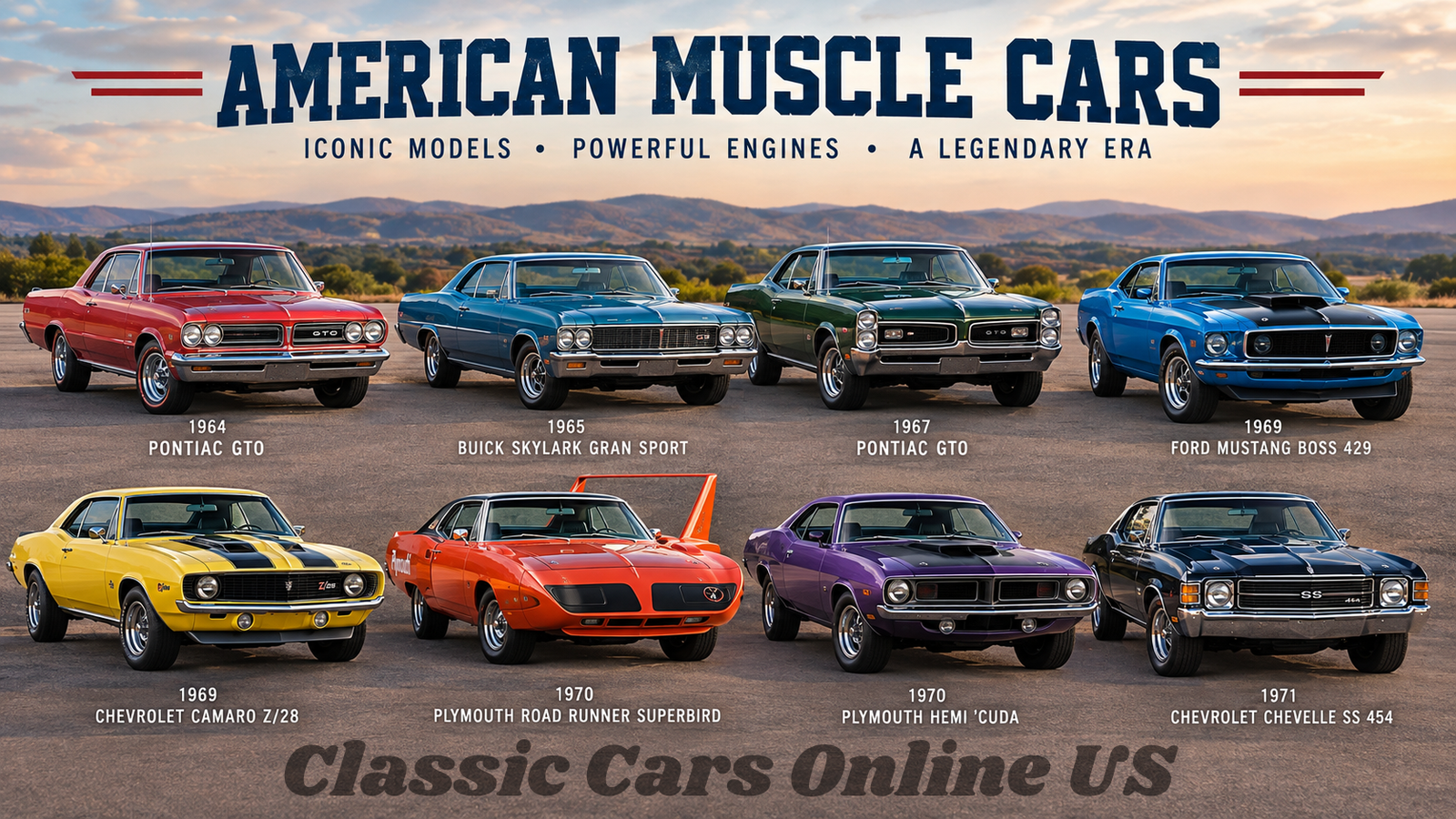
I’ll be back to update that featured image!
American muscle cars are some of the most recognizable automobiles ever built. With powerful V8 engines, bold styling and the sound of an exhaust system under acceleration, these cars helped define an era of American automotive history.
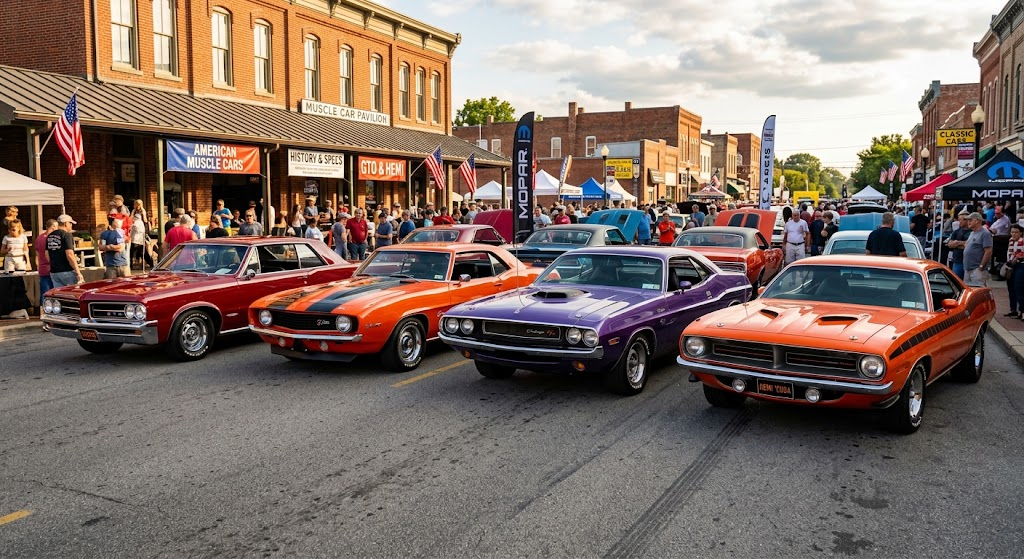
The classic muscle car era is usually associated with the 1960s and early 1970s. During those years, automakers competed to build faster, more exciting cars that ordinary buyers could take home from a dealership. The result was a remarkable collection of vehicles, from the Pontiac GTO and Chevrolet Chevelle SS to the Plymouth Road Runner and Ford Mustang Boss 429.
But what exactly makes a car a muscle car? How did the horsepower race begin? And which classic American muscle cars are worth knowing?
Let’s look at the history, engineering and standout models that made these cars legendary.
What Is an American Muscle Car?
An American muscle car is generally understood as a high-performance car built by an American automaker, often featuring a powerful V8 engine, rear-wheel drive and a relatively affordable price compared with exotic sports cars.
The classic muscle car formula emphasized straight-line acceleration and accessible performance. Many were based on intermediate-sized cars, although the category also includes smaller pony cars and larger performance models.
Typical muscle car features include:
- A powerful V8 engine.
- Rear-wheel drive.
- A two-door coupe, hardtop or convertible body style.
- Performance-oriented suspension and brakes.
- A manual or automatic transmission.
- Bold styling and distinctive badging.
- Available performance packages and engine upgrades.
Not every American performance car fits the traditional definition. The Ford Mustang, early Chevrolet Camaros and early Plymouth Barracudas are often described as pony cars because they were smaller and styled around the Mustang concept. Some versions, however, offered the same kind of big-engine performance associated with muscle cars.
The terms overlap, and enthusiasts may use them differently depending on the car and the era.
How the American Muscle Car Era Began
The 1964 Pontiac GTO
The modern muscle car story often begins with the 1964 Pontiac Tempest GTO.
Pontiac placed a 389-cubic-inch V8 from its larger cars into the intermediate-sized Tempest. The result was a car with a strong combination of power, performance and a price that appealed to a wider range of buyers.
The GTO was offered as a performance option package for the 1964 Pontiac Tempest. It included a 389 V8, special badging, dual exhausts and available performance equipment.
General Motors lists the 1964 GTO’s standard engine at 325 horsepower. Buyers could also select the available Tri-Power engine, which used three two-barrel carburetors and produced 348 horsepower.
Pontiac sold 32,450 Tempests with the GTO package during the 1964 model year.
Source: General Motors Heritage Collection: 1964 Pontiac GTO
The Horsepower Race
The GTO’s success helped encourage other manufacturers to develop their own performance cars.
Ford, Chevrolet, Dodge, Plymouth, Buick, Oldsmobile and AMC all competed for attention in the growing performance market. Buyers could choose from a wide range of engines, body styles and options.
The competition wasn’t only about horsepower. Automakers also used styling, racing involvement and advertising to attract buyers.
By the late 1960s, the muscle car market had become one of the most exciting parts of the American auto industry.
What Made Muscle Cars So Powerful?
The engines were a major part of the appeal, but horsepower was only one piece of the equation.
V8 Engines
A V8 engine has eight cylinders arranged in two banks in a V-shaped configuration. This layout allows manufacturers to produce substantial power while fitting the engine into a practical automotive package.
V8 engines became a defining feature of classic American muscle cars because they offered the power and torque needed for strong acceleration.
Different manufacturers developed their own engines and performance systems. Chevrolet small-block V8s, Pontiac V8s, Ford big-block engines and Chrysler’s Hemi engines all became important parts of muscle car history.
What Does Cubic-Inch Displacement Mean?
Classic muscle car specifications often use cubic inches to describe engine size.
For example:
- 389 cubic inches: Pontiac V8 used in the early GTO.
- 426 cubic inches: Famous Chrysler Hemi engine.
- 440 cubic inches: Chrysler big-block engine used in several Mopar performance cars.
- 454 cubic inches: Chevrolet big-block engine used in high-performance Chevelles and other models.
Engine displacement measures the combined volume swept by the pistons. A larger displacement engine can potentially produce more torque, although the actual output depends on many factors, including compression, cylinder heads, camshaft design, carburetion and exhaust systems.
Why Hemi Engines Became Famous
The Hemi name comes from hemispherical combustion chambers.
Chrysler developed and used hemispherical-head engines in several generations. The design became especially famous in the 1960s and 1970s, when the 426 Hemi was offered in selected high-performance cars.
The 426 Hemi developed a reputation for power and drag-strip performance. It became one of the most desirable engines in the Mopar muscle car world.
A Hemi badge alone does not tell the entire story of a car’s value or performance. The exact engine, transmission, body style, factory options and documentation all matter.
Classic American Muscle Cars Worth Knowing
1964 Pontiac Tempest GTO
The 1964 Pontiac GTO is one of the most important cars in muscle car history.
It combined a midsize body with a powerful 389-cubic-inch V8 and performance equipment that helped establish the modern muscle car formula.
Key specifications:
- Engine: 389-cubic-inch V8.
- Standard advertised horsepower: 325.
- Available Tri-Power engine: 348 horsepower.
- Body styles: Coupe, hardtop and convertible.
- 1964 GTO package sales: 32,450.
Why it matters: The GTO demonstrated that a relatively ordinary-looking American car could deliver serious performance without the price of an exotic sports car.
Source: General Motors Heritage Collection: 1964 Pontiac GTO
1965 Buick Skylark Gran Sport
Buick entered the growing muscle car market with the Skylark Gran Sport.
The Gran Sport offered a powerful V8 in a stylish intermediate-sized car. It appealed to buyers who wanted performance without necessarily choosing a Pontiac, Chevrolet or Mopar.
The 1965 model is an interesting example of how quickly the muscle car market expanded after the GTO’s introduction.
When researching a specific Gran Sport, pay attention to the engine and options. Buick offered several performance configurations, and not every Skylark with sporty styling is a factory Gran Sport.
1967 Pontiac GTO
The 1967 Pontiac GTO continued the success of the original and became one of the most recognizable cars of the era.
It was available with a 400-cubic-inch V8 and offered a range of performance equipment, including a four-speed manual transmission and optional hood-mounted tachometer.
The GTO’s combination of styling, power and options helped make it one of the best-known muscle cars of the 1960s.
What to look for:
- Correct engine and transmission.
- Factory performance options.
- Original body and trim.
- Documentation supporting the car’s identity.
- Quality of restoration.
A restored GTO can be valuable, but the quality and authenticity of the restoration are important factors.
1969 Ford Mustang Boss 429
The 1969 Ford Mustang Boss 429 is one of the most famous high-performance Mustangs ever produced.
Ford developed the Boss 429 to meet NASCAR homologation requirements. The large 429-cubic-inch engine required special installation work, and the car received modifications to accommodate it.
The Boss 429 is particularly notable because it combines Mustang styling with a very large engine and limited production.
Only a small number were produced for the 1969 model year, making original examples highly desirable among collectors.
Important details:
- 429-cubic-inch V8.
- Special engine installation and chassis modifications.
- Limited production.
- Built for NASCAR homologation purposes.
When researching a Boss 429, documentation is especially important. A standard Mustang converted to resemble a Boss 429 is not the same as a genuine factory-built car.
1969 Chevrolet Camaro Z/28
The Chevrolet Camaro Z/28 is another major name in classic American performance.
The Z/28 was developed with road racing in mind and became closely associated with Chevrolet’s participation in the SCCA Trans-Am racing series.
The 1969 Z/28 used a 302-cubic-inch V8 and offered performance equipment designed to improve handling and driving response.
Notable features include:
- 302-cubic-inch V8.
- Performance suspension.
- Four-speed manual transmission available.
- Special exterior and interior details.
- Racing-inspired development.
The Z/28 is a useful reminder that muscle car performance wasn’t only about the biggest engine. Handling, braking and the intended use of the car also mattered.
1970 Plymouth Road Runner Superbird
The Plymouth Road Runner Superbird is one of the most distinctive American muscle cars ever built.
Its long nose and enormous rear wing make it instantly recognizable. Unlike many muscle cars that were primarily designed for street performance, the Superbird was closely tied to NASCAR racing.
The aerodynamic body modifications were intended to improve high-speed performance on the track.
Notable features:
- Aerodynamic nose cone.
- Large rear wing.
- Available 440-cubic-inch V8.
- Available 426 Hemi engine.
- NASCAR homologation connection.
The Superbird is important because it shows how racing influenced the design of production muscle cars.
Its unusual appearance also makes it a standout among classic Mopar vehicles.
1970 Plymouth Hemi ‘Cuda
The 1970 Plymouth Barracuda, especially the Hemi-powered versions, is among the most sought-after classic Mopar muscle cars.
The Barracuda was redesigned for 1970 with a more aggressive appearance and a range of powerful engine options.
The 426 Hemi version combined the Barracuda’s styling with Chrysler’s legendary high-performance engine.
Key points:
- 426-cubic-inch Hemi V8 available.
- Two-door performance car.
- Distinctive 1970 redesign.
- Available four-speed manual transmission.
- Rare factory Hemi configurations.
Original Hemi ‘Cudas are especially important to collectors. Engine identity, factory documentation and the car’s original configuration can have a major effect on value.
1971 Chevrolet Chevelle SS 454
The Chevrolet Chevelle SS 454 is a classic example of the big-engine muscle car.
The Chevelle was an intermediate-sized Chevrolet, and the SS package offered a more aggressive appearance and performance equipment.
The 454-cubic-inch V8 made the SS 454 a serious contender in the muscle car market.
Notable features:
- 454-cubic-inch V8.
- SS performance package.
- Available manual transmission.
- Performance suspension.
- Distinctive SS styling.
The Chevelle SS 454 remains popular because it combines a recognizable Chevrolet body with the appeal of a large-displacement V8.
Why Muscle Car Specifications Matter
When comparing classic American muscle cars, horsepower and engine size are only part of the story.
A car’s performance depends on the combination of its engine, transmission, weight, gearing and tires.
For example, two cars with similar horsepower can perform differently if one has a lighter body or more favorable rear-axle gearing.
Important Specifications to Compare
- Engine displacement and type.
- Factory horsepower rating.
- Torque.
- Transmission.
- Rear-axle ratio.
- Curb weight.
- Body style.
- Factory performance options.
- Production numbers.
Specifications can also vary by engine configuration, transmission and testing method. Factory ratings from different years should not always be compared as if they were measured under identical conditions.
American Muscle Cars and Collecting Today
Classic muscle cars remain popular with collectors because they combine historical importance, mechanical interest and unmistakable styling.
Some buyers are drawn to the most powerful and rarest models. Others prefer cars that are easier to maintain, more affordable to restore or more comfortable to drive.
There is no single best muscle car for every collector.
What to Research Before Buying
If you’re considering a classic American muscle car, start with the car’s identity and documentation.
A practical checklist includes:
- Confirm the year, make and model.
- Verify the engine and transmission.
- Check the VIN and available factory documentation.
- Look for rust and previous accident damage.
- Inspect the frame, floors and body panels.
- Review the restoration history.
- Compare the asking price with similar documented cars.
- Have a qualified mechanic inspect the vehicle.
A car advertised as a genuine factory performance model should have documentation supporting that claim.
A clone or tribute car can still be enjoyable, but it should be represented accurately.
American Muscle Cars in Today’s Market
The classic muscle car era changed the American automotive industry.
It encouraged manufacturers to experiment with powerful engines, performance packages and racing-inspired designs. It also created cars that remain recognizable decades after they left the factory.
From the 1964 Pontiac GTO to the 1970 Plymouth Hemi ‘Cuda, these cars represent an important period in automotive history.
They are remembered not only for horsepower, but for the engineering, styling and competition that made the era so memorable.
Whether you’re researching a classic car, restoring one or simply enjoying the history, American muscle cars offer plenty to explore.
Thinking about buying a classic muscle car? Download the Classic cars Online US free Classic Muscle Car Buyer & Ownership Checklist (below) to help you inspect a car, compare listings and keep track of important ownership details.
Classic Cars Online is your resource for classic car specifications, history and insights.
Join the Classic Cars Online US Facebook group to chat with other classic car enthusiasts online!