
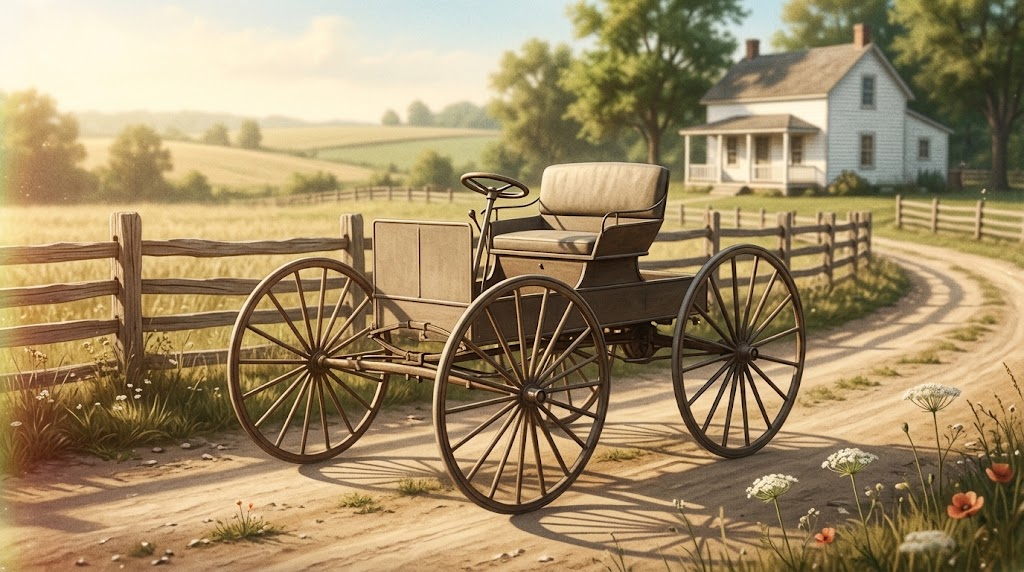
In 1907, you could buy a brand-new automobile for $250. Not a down payment, the whole car. The 1907 Success Auto-Buggy from St. Louis, Missouri, was a brass-era car built for people who wanted to stop feeding a horse and still keep the look of the family buggy. So, what was it like to drive America’s $250 car?
First Impressions: A Buggy That Forgot Its Horse
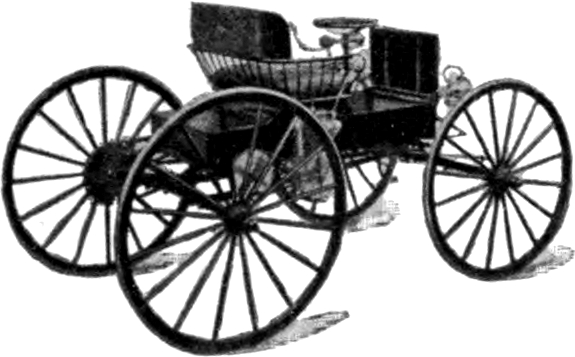
Climb up, and you’re sitting in what is basically a piano-box buggy body on tall, thin wheels, with a steering wheel mounted right where the reins used to be. The high wheels weren’t a styling choice. They were meant to straddle ruts and ride over the rough country roads most Americans still lived on.
At 500 pounds, this was a featherweight. There was no windshield, no doors, and no suspension beyond platform-type springs. Expect to feel every washboard ridge, and expect your hat to need a chin strap.
Starting It and Getting Rolling
With a single vertical cylinder and a jump-spark ignition running off dry cells, you’d be setting the spark and throttle by hand and getting the engine going before you ever climbed aboard. Once it caught, you’d hear a one-lunger thump with a cooling fan whirring beside it.
The controls would have been unlike anything in a modern car:
- Foot pedals worked the planetary gearset. One pedal for low, one for high, one for reverse.
- A band clutch engaged the drive, so you’d ease into it rather than slam it.
- Spark and throttle set your pace by hand.
- The brake acted on the transmission, not the wheels, so stopping was a gentle suggestion rather than a command. You planned ahead, or you kept going.
How the Steering Would Feel
The sprocket-and-chain steering is the detail I’d linger on. It’s a direct mechanical link with a bit of slack, so you’d steer with small, deliberate motions and keep your eyes well down the road. At a few miles per hour on a dirt lane, that was perfectly manageable.
On the Road
With 4 horsepower and two forward speeds, this was no speed demon. It was a tool for getting to town, to church, or to a neighbor’s farm without a horse. Hills would have been the real test. You’d drop into low gear early, listen to the engine work, and probably be glad of the air cooling and fan on a long summer grade.
Full Specifications of the 1907 Success Auto-Buggy Model 3
These specs were retrieved from the public domain publication: An Illustrated Directory of the Specifications of All Domestic and Foreign Motor-cars and Motor Business Wagons, Gasoline, Steam and Electric, Sold in This Country, 1907.
- Price: $250
- Body: Piano box
- Seats: 2 persons
- Weight: 500 pounds
- Wheelbase: 62 inches
- Tread: 56 inches
- Tires, front: 40 × 1 in.
- Tires, rear: 44 × 1 in.
- Steering: Sprocket and chain
- Brakes: On transmission
- Springs: Platform type
- Frame: Wood and angle steel
- Bore and stroke: 3¼ in. × 3 in.
- Cylinders: 1, vertical, at side of body
- Valves: At side of cylinder
- Motor suspension: From angle bars projecting at side of body
- Cooling: Air and fan
- Ignition: Jump spark
- Current supply: Dry cells
- Carburetor: Spray, mixing valve
- Lubrication: Splash and grease cups
- Motor control: Spark and throttle
- Clutch: Band
- Change gear: Planetary type
- Speeds: 2 forward and reverse
- Gear control: Foot pedals
- Drive: Side chain
The Story Behind the Car
The company’s founder, John C. Higdon, was a patent lawyer who advertised that there was no patent on his vehicle and everyone was free to copy it. He later changed his mind and began suing other manufacturers over design patents. The company folded before that litigation was resolved. 1909 was its final year of production.
Success also pushed some bold advertising. The company claimed 100 mpg, which is best treated as ad copy rather than a measured figure, as noted by the conceptcarz website.
Some Reliable Sources to Check Out for More Info on the 1907 Success Auto-Buggy Model 3
- American-Automobiles.com, “The Success Automobile & The Success Auto-Buggy Mfg. Co.”: period ads and model details
- Wikipedia, “Success Automobile Manufacturing Company”: company overview and the patent lawsuits
- Conceptcarz.com, the 1906 Model A and 1908 Model C pages: production and history notes
- Barrett-Jackson’s 1906 Success Motor Buggy lot page: a surviving, restored example sold at its 2013 Scottsdale auction
- Bonhams’ 2013 Scottsdale sale of a 1908 Model C (reported at $18,400)
- Beverly Rae Kimes, Standard Catalog of American Cars 1805–1942: the standard print reference, worth citing as the deeper source
Download a free printable Success Auto-Buggy adult coloring page and build sheet!
You can also check out listings featuring marketing materials and anything related to the 1907 Success Auto-Buggy on eBay by clicking here, at this affiliate link.