
Updated 8/25/2026
“Cool” gets thrown around a lot in the muscle car world, but it’s rarely defined. Is it about horsepower? Rarity? The sound it makes at idle? The truth is that muscle car cool isn’t one thing — it’s a mix of engineering, history, and a little bit of attitude that either comes together or it doesn’t. Here’s a real way to think about it, using facts and criteria instead of just gut feeling.
What Actually Makes a Muscle Car Cool
Coolness in the muscle car world tends to come down to a handful of measurable traits rather than pure opinion. A car earns its reputation through some combination of:
- Engineering ambition — engines, suspensions, or drivetrains that pushed past what the factory normally offered
- Scarcity — low production numbers, rare factory options, or a short model run
- Cultural footprint — appearances in film, TV, racing, or music that cemented the car in public memory
- Design confidence — styling that took a risk instead of playing it safe
- Driving character — a personality behind the wheel that a spec sheet can’t fully capture
No single factor makes a car cool on its own. A rare car with boring styling doesn’t turn heads, and a good-looking car built by the thousands doesn’t feel special. The best muscle cars stack several of these traits at once.
Three Cars That Prove the Point
Instead of judging by popularity alone, it helps to look at cars that earned their reputation in different ways.
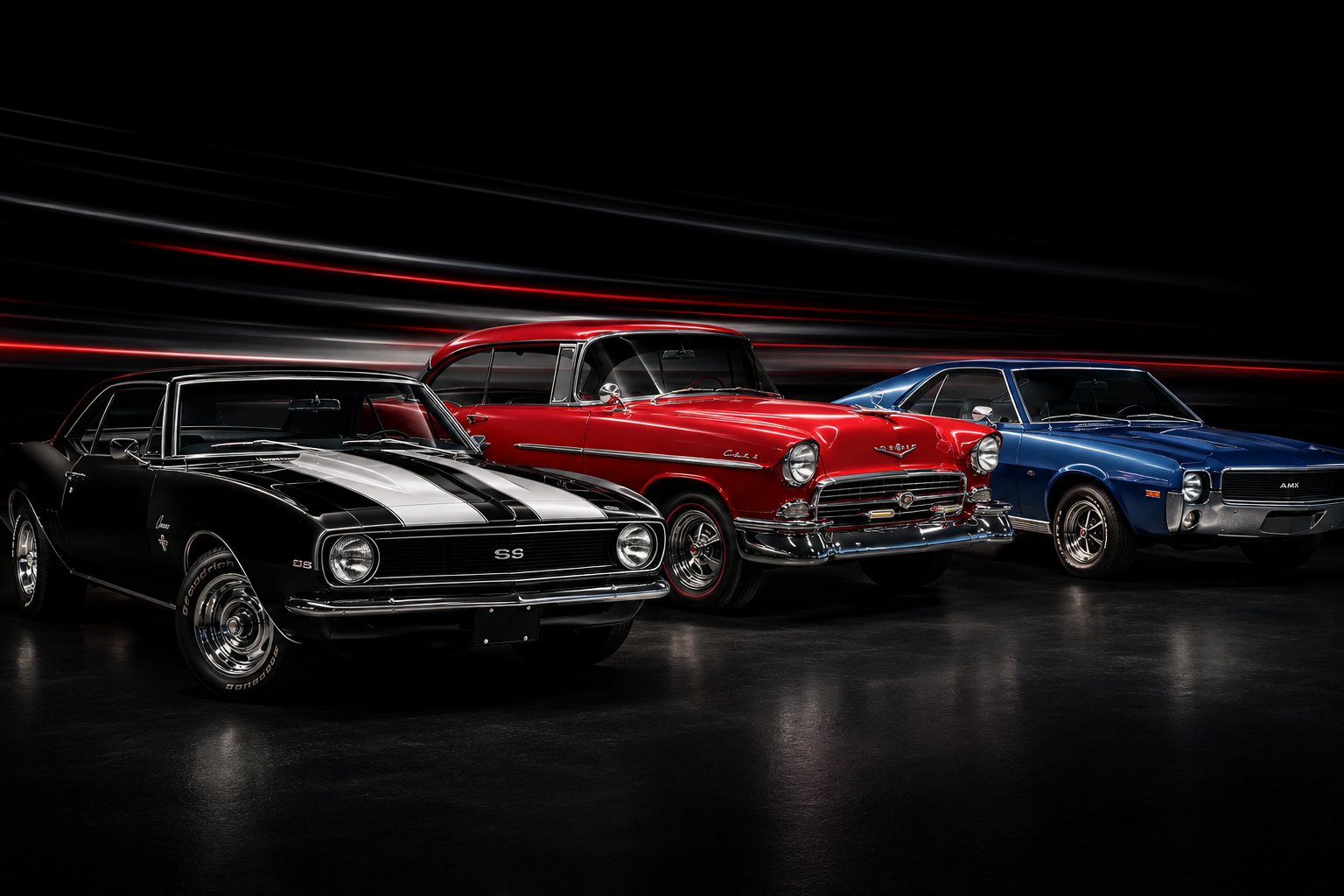
1. First-gen Chevy Camaro

The first-generation Camaro (1967-1969) is a case study in getting the fundamentals right. Chevy built it on the same basic platform as the economy-minded Chevy II, then offered buyers a wide spread of engine choices — from mild small-blocks to big-block and Z/28 road-race packages — so the same body could be configured as a daily driver, a drag car, or a corner-carver.
That flexibility is a big reason first-gen Camaros remain some of the most sought-after muscle cars with collectors and hot rodders alike.
2. ’66 & ’67 Dodge Charger
The 1966-1967 Dodge Charger made its case through styling and engineering detail rather than sales volume. Early Chargers didn’t outsell the later ’68-’70 fastback generation, and they never got a “Dukes of Hazzard” boost the way the second-gen car did — but the fastback roofline, hidden headlights, and full-width taillight treatment gave it a distinct identity, and the interior’s four-gauge instrument cluster is still considered one of the best factory dashboards of the era.
It has a smaller, more devoted following than some of its rivals, but that following is fierce.
3. AMC’s AMX
The AMC AMX proves that scarcity and a willing-to-be-different attitude can carry a car on their own. American Motors built its reputation mostly on practical family cars, which made the AMX something of an outlier — a genuine two-seater with an unusually short wheelbase, built by a company better known for the Rambler than for performance.
It never had Ford or GM-level marketing behind it, but its oddball specs and limited production have made it a favorite among collectors looking for something outside the mainstream muscle car lineup.
The Coolness Checklist for Your Own Car

If you’re trying to figure out where your own muscle car lands, it helps to walk through the same categories collectors and appraisers use:
- Matching numbers: Does the engine, transmission, and rear end match what left the factory? Numbers-matching cars carry a real value premium.
- Factory options: Rare factory codes (specific engines, trim packages, or performance options) can turn a common model into something scarce.
- Production count: Look up how many were built with your exact combination of engine, transmission, and body style — the number is often smaller than people assume.
- Documentation: Broadcast sheets, build sheets, and original window stickers add credibility that a car simply “looks right.”
- Condition and originality: A well-preserved original car is often more desirable to collectors than a heavily modified one, even if the modified car is faster.
None of these require anyone else’s approval. They’re just the same criteria the market already uses to separate an ordinary muscle car from a genuinely significant one.
What This Means for You
If your car checks several of these boxes, you’re not just driving something fast — you’re driving a piece of engineering or cultural history that few other cars can claim.
And if it doesn’t check every box?
That’s fine too.
Plenty of muscle cars earn their reputation through pure driving character, and that’s a kind of cool no spreadsheet can measure. The real answer is that “cool enough” was never about matching someone else’s checklist in the first place — it’s about whether the car still gets your attention every time you start it up.
Think we got the ranking right? Argue your case in the Classic Cars Online US Facebook group — we want to hear which muscle car you think we slept on.