
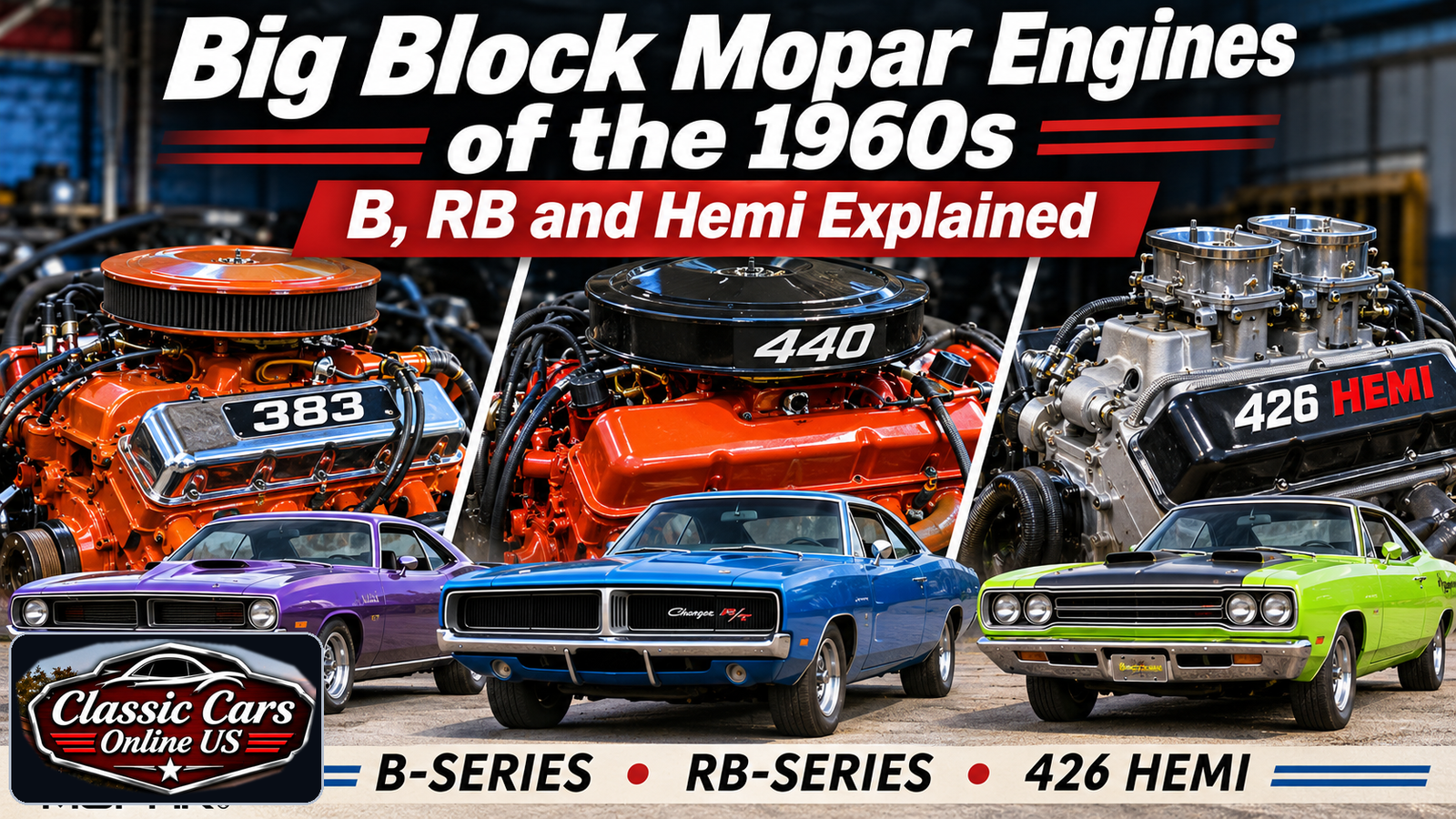
In my opinion, muscle cars are one of the most American stories ever put on four wheels. Take a regular family car, drop in an enormous V8, and let the tires do the talking. Collectors of every age still chase these cars, whether they lived through the 1960s or just wish they had.
Every U.S. automaker joined the fun. This article looks at the Chrysler side of the story: the big block engines that powered Plymouth, Dodge and Chrysler performance cars. Gas was cheap and horsepower sold cars, so Mopar engineers went big.
What Makes an Engine a “Big Block”?
A big block is a larger family of V8 engines. Compared with smaller engine designs, it has a larger overall block and more room for displacement, which is the total volume of its cylinders, measured in cubic inches. More displacement can mean more power and torque, although other factors, including compression, cylinder-head design and airflow, also matter.
Chrysler’s big blocks came in two related families, called B and RB. The letters were internal designations. The “B” did not mean there was an “A” before it. It identified one of Chrysler’s engine series.
The B Engine Family
The B engines arrived in 1958. Chrysler’s earlier first-generation Hemi V8s were being phased out, and the new B engines used wedge-shaped combustion chambers instead. That design was simpler and less expensive to manufacture, while still offering plenty of performance.
B engines share a 3.375-inch stroke. The stroke is how far the piston travels up and down inside the cylinder. Common B-series sizes include:
- 350 cubic inches
- 361 cubic inches
- 383 cubic inches
- 400 cubic inches
The 350 was a short-lived offering, while the 361 and 383 became familiar names in Chrysler’s lineup. The 400 arrived later, in 1972, so it falls outside the 1960s period covered here but belongs to the same engine family.
The 383 became a favorite among Mopar enthusiasts. It powered a long list of Plymouth, Dodge and Chrysler models, including several performance cars, and you’ll still find it under the hood of plenty of classics today.
The RB Engine Family
The “RB” stands for raised block. Chrysler built these engines with a taller block deck than the B series, allowing for a longer 3.75-inch stroke. That longer stroke helped produce the torque that made these engines so popular.
The RB lineup ran from 1959 into the late 1970s. Its best-known members included:
- 383: An early RB version produced for a limited time, separate from the more familiar B-series 383.
- 413: Famous in the early Max Wedge performance and drag-racing cars.
- 426 Wedge: A larger performance engine that followed the 413 Max Wedge.
- 440: One of the most popular Mopar big block engines ever built.
The B and RB engines share some design features and components, but they are not identical. Their main bearing journal sizes are different, and the taller RB block requires different components in several areas. The RB is also physically larger and heavier.
What About the 426 Hemi?
The legendary 426 Hemi deserves its own mention. It used the RB-style block dimensions and a 3.75-inch stroke, but its cylinder heads featured hemispherical combustion chambers instead of the wedge-shaped chambers found in the standard B and RB engines.
The hemispherical design allowed Chrysler to use large valves and develop excellent airflow through the cylinder heads. That helped the engine produce tremendous power, particularly at higher engine speeds.
Chrysler developed the 426 Hemi for NASCAR and drag racing in the mid-1960s, then offered a street version beginning with the 1966 model year. Fans nicknamed it the “Elephant Engine” because of its impressive size and weight.
The Hemi also had a reinforced bottom end, including cross-bolted main bearing caps, designed to handle the demands of high-performance use.
The Cars That Wore Them
These engines gave Mopar fans some of the most memorable cars of the era:
- Plymouth Road Runner: Introduced in 1968 with a high-performance 383 as standard equipment and the 426 Hemi available as an option.
- Dodge Super Bee: A close cousin of the Road Runner, introduced in 1968 as Dodge’s affordable performance offering.
- Dodge Charger: A favorite of street racers and movie fans, available with several powerful B and RB engines, including the 426 Hemi.
- Plymouth Barracuda and Dodge Challenger: Both became part of Chrysler’s redesigned E-body lineup for 1970.
- Plymouth Hemi ‘Cuda: One of the most sought-after Mopar muscle cars, combining the redesigned Barracuda body with the legendary 426 Hemi.
Several of these cars started life as ordinary models. Chrysler dropped big engines into them, added stripes and performance equipment, and sold them to a very eager crowd.
Swapping and Restoring Big Block Mopars
Restoring a classic Mopar can be rewarding, and it can also be humbling. B and RB engines share some basic design features, and both use the same general bellhousing bolt pattern. That’s one reason builders have long installed a 440 in cars that originally came with a 383.
“Similar” isn’t the same as “identical,” though. The taller RB block takes up more room, and swaps can bring a few headaches. Exhaust manifolds, headers, engine mounts, intake manifolds and hood clearance can all require attention. Parts also vary by year, so matching numbers and casting codes matter if you’re chasing originality.
A good restoration shop earns its money in those details. If you’re a beginner, ask questions early, find a model-specific club or forum, and expect surprises. Every old car has a few.
If you plan to tackle an engine yourself, a solid rebuild or identification guide is worth having on the workbench. Look for one that covers big block Mopar engines and explains block identification, casting numbers and component differences.
Where to Read More About Specs, Production Info and Engine Codes
For a deeper look at specifications, production years and engine codes, the Wikipedia entries on the Chrysler B engine and Chrysler RB engine are a starting point. They’re handy for checking displacement, bore and stroke figures before you buy parts. And also:
- NHRA: 426 Hemi – Drag Racing’s Ultimate Engine Architecture
- Quality Engineered Components: B/RB Engine Identification
Big Block Mopar Muscle Today
The big blocks may be gone from new cars, but the spirit hasn’t disappeared. Dodge revived the Challenger and Charger nameplates with modern muscle cars that borrowed heavily from the 1960s look and attitude. The Challenger’s production run ended after the 2023 model year, marking the end of an era for that nameplate.
Meanwhile, the original cars remain popular with collectors and enthusiasts at auctions, car shows and weekend cruise-ins.
Hearing a Big Block Mopar Come Alive
Few sounds in the car world match a big block Mopar rumbling to life. Whether it’s a 383 in a Road Runner, a 440 in a Charger or a Hemi in a ‘Cuda, these engines are a big reason the 1960s still feel so exciting. Learning how they work makes them even more fun to appreciate.
Join the conversation!
Follow Classic Cars Online US on YouTube for more classic-car features, performance stories and automotive history.
Join us on Facebook to share your favorite muscle cars, compare notes with other enthusiasts and keep the conversation going.
There’s always another amazing car worth talking about. We’ll see you at the starting line!