
Originally published April 10, 2016 | Updated November 2, 2026
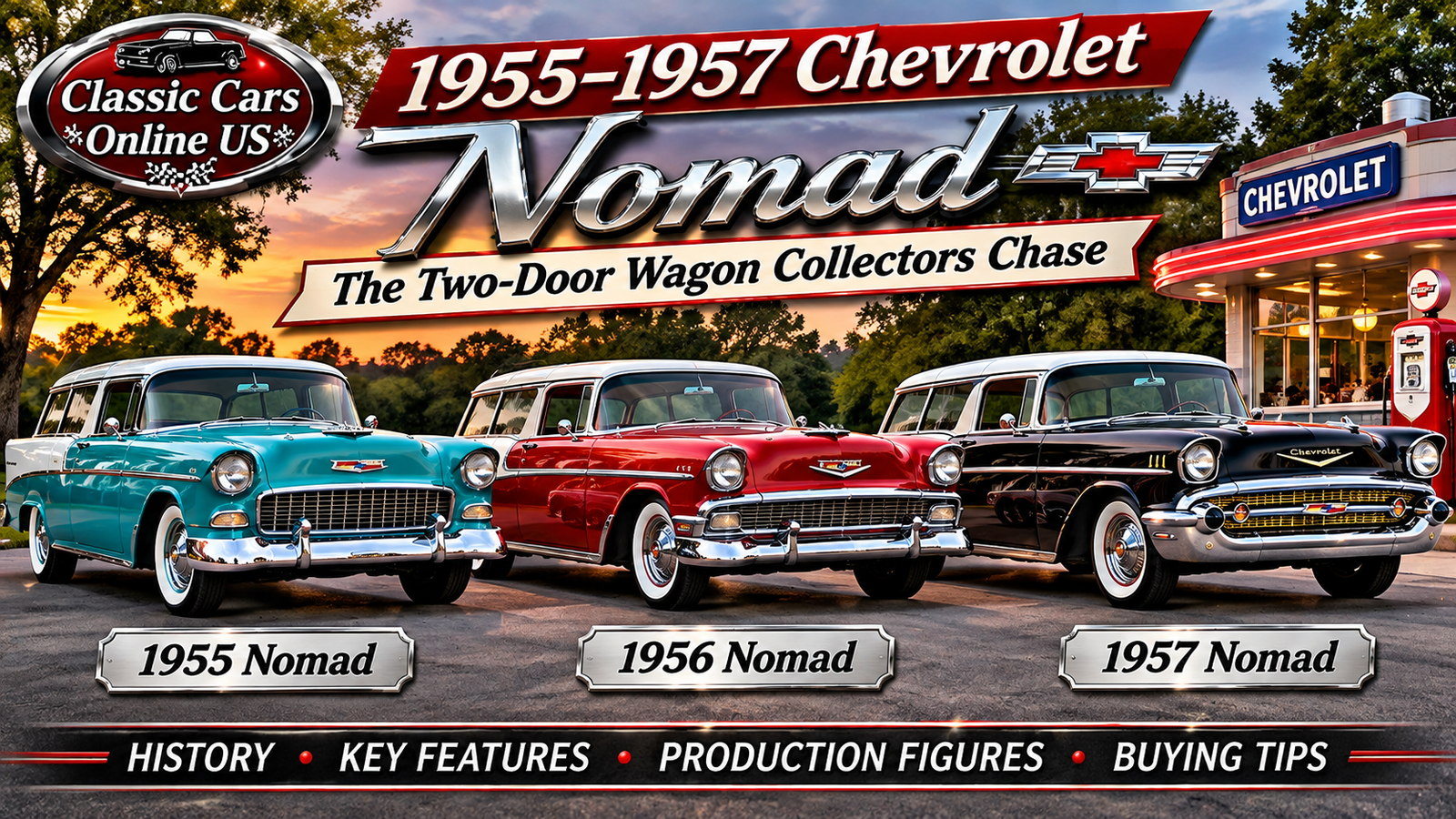
Park a 1955–1957 Chevrolet Nomad at a car show and watch what happens. People who walk right past rows of Bel Air coupes and convertibles often stop and circle the wagon. It has that distinctive roofline, those sweeping rear windows and a shape that still looks like nothing else from the decade.
The Nomad has a show-car pedigree, a relatively short production run and a loyal following. Here’s how it came to be, what makes it different from other Tri-Five Chevys and what to know if you’re thinking about buying one.
From Motorama Dream Car to Showroom Wagon
The Nomad started as a dream car. Chevrolet introduced a Corvette-based Nomad concept at General Motors’ 1954 Motorama, a traveling show where GM displayed futuristic designs and explored ideas for future production vehicles.
The concept attracted enough attention that Chevrolet developed a production version for 1955. Although the production car shared the concept’s distinctive roofline and sporty wagon proportions, it was based on the full-size Chevrolet passenger-car platform rather than the Corvette.
The production Nomad joined the upscale Bel Air series. Its design included a sloping roof, angled center pillar, wraparound rear side glass and distinctive tailgate treatment. These features gave it a more sophisticated appearance than the more conventional station wagons in Chevrolet’s lineup.
The Nomad wasn’t Chevrolet’s first two-door wagon. The company already offered other two-door wagon models, including the Handyman. What made the Nomad different was its combination of two-door practicality, hardtop-inspired styling and Bel Air trim.
What Sets a Nomad Apart From Other Tri-Five Chevys?
“Tri-Five” refers to the 1955, 1956 and 1957 Chevrolet models. Chevrolet offered several passenger-car body styles during those years, including two-door and four-door wagons. The Nomad stood apart from both.
Here are some of its defining features:
- Distinctive roofline: The sloping roof and angled center pillar gave the Nomad a sleek profile.
- Hardtop-inspired side glass: Its frameless door glass and sweeping rear side windows helped create the appearance of a sporty hardtop.
- Unique rear styling: The tailgate and rear glass treatment gave the Nomad a look unlike other Chevrolet wagons.
- Bel Air trim: The Nomad was part of Chevrolet’s top passenger-car series, with upscale exterior and interior details.
- Model-specific parts: Certain trim, glass, tailgate and interior components are unique to the Nomad, making original examples and correct restoration parts especially important to collectors.
The result was a car that combined the usefulness of a station wagon with the styling of a sporty personal car. It was an unusual combination for the 1950s, and it remains a big part of the Nomad’s appeal.
Low Production, High Demand
Chevrolet built 22,375 Nomads during the original three-year production run. That was a relatively small number compared with the millions of Tri-Five Chevrolets produced across all body styles.
Here’s the production breakdown:
| Model year | Nomads built |
|---|---|
| 1955 | 8,386 |
| 1956 | 7,886 |
| 1957 | 6,103 |
| Total | 22,375 |
Production declined each year, making the 1957 model the least common of the original three.
The Nomad’s limited production and distinctive styling helped establish its collector following. It wasn’t necessarily intended to be a rare specialty car, but it occupied a more expensive position in Chevrolet’s lineup than many other wagons. Its appeal didn’t translate into the kind of sales volume Chevrolet achieved with its more conventional models.
The original Nomad design ended after 1957. Chevrolet continued using the Nomad name on later wagons, beginning with a four-door model for 1958, but those cars were quite different from the original two-door models.
The irony is that the limited production that once made the Nomad a less common sight on the road is now part of its appeal to collectors.
1955, 1956 and 1957 Nomads Compared
All three model years share the basic Nomad design, but Chevrolet made changes to the styling and available equipment each year. Those details are important when identifying an original car or planning a restoration.
1955 Chevrolet Nomad

The 1955 Nomad introduced the production version of the distinctive two-door wagon. It featured Chevrolet’s new styling for the model year, including the egg-crate grille, rounded body lines and prominent rear wheel openings.
The 1955 model was also part of the first year of Chevrolet’s small-block V8. Buyers could choose the 235-cubic-inch six-cylinder engine or a 265-cubic-inch V8, depending on configuration.
The 1955 model has its own identifying details, including the original rear wheel-opening shape and year-specific trim.
1956 Chevrolet Nomad

Chevrolet refreshed the Tri-Five styling for 1956. The Nomad retained its distinctive roof and body shape, but received updated front-end styling, revised trim and other year-specific details.
The grille extended farther across the front, and the parking lights were rectangular. Chevrolet also revised the side trim and rear details.
The 1956 Nomad continued with the 235-cubic-inch six and 265-cubic-inch V8 engine options. Its styling changes make it easy to distinguish from the 1955 model once you know what to look for.
1957 Chevrolet Nomad

The 1957 Chevrolet is often the most recognizable of the Tri-Five models. Chevrolet gave the entire lineup a more elaborate appearance, with a wider grille, sculpted front-end details and the tailfins that became a defining feature of the era.
The 1957 Nomad carried those changes into its distinctive wagon body. It also offered the new 283-cubic-inch small-block V8, including optional fuel-injection equipment.
With production of just 6,103 cars, the 1957 Nomad was the least common of the original three model years.
Which year is best? That’s largely a matter of personal taste. Some collectors prefer the cleaner styling of the 1955, while others favor the updated appearance of the 1956 or the bold design of the 1957. Condition, originality, documentation and budget matter more than choosing a particular year simply because it’s popular.
What Does a Chevrolet Nomad Cost Today?
Original Tri-Five Nomads can command substantial prices, especially when they’re restored to a high standard or retain desirable original equipment.
However, not every Nomad is a six-figure car. Condition, originality, restoration quality, engine and transmission combinations, documentation and market demand all influence value.
A fully restored example with correct parts and a well-documented history will generally attract more attention than a project car with extensive rust or missing Nomad-specific components.
Before making an offer, check current valuation guides and recent auction results. Pay attention to actual completed sales rather than relying only on asking prices. A car listed for a particular amount isn’t necessarily worth that amount.
Restoration costs deserve just as much attention as the purchase price. Nomad-specific glass, trim, tailgate components and other parts can be expensive to locate. A seemingly inexpensive project can become a costly undertaking if too many original pieces are missing.
Buying Tips for a Tri-Five Nomad
A Nomad can be a rewarding addition to a collection, but it’s worth doing your homework before buying. Its distinctive body design and collector value make originality and condition especially important.
Here are some things to check:
- Confirm its identity. Don’t assume a car is an original Nomad just because it has the right roofline and trim.
- Check the VIN, body information, identification tags and available documentation.
- Have someone familiar with Tri-Five Chevrolets help verify the car.
- Look carefully for rust. Inspect the floors, inner rockers, body mounts, lower body panels, rear body area and roof structure.
- Pay particular attention to areas where water can collect or seams can trap moisture.
- Check the glass and trim. Nomad-specific parts can be difficult and expensive to replace.
- Missing rear glass, tailgate trim and other unique pieces can add considerably to restoration costs.
- Inspect the tailgate and rear bodywork. Look for signs of previous repairs, poor alignment, corrosion and damage.
- Review the restoration history. Ask for receipts, photographs and records of previous work.
- Documentation can help establish what is original and what has been replaced.
- Have an expert inspect it. A mechanic or restoration specialist familiar with Tri-Five Chevrolets can identify problems that might not be obvious during a casual inspection.
For additional help identifying original parts and model-year details, take a look at the Tri-Five Chevrolet Data and ID Guide: 1955, 1956, 1957*. A reference guide can be especially useful when comparing identification information, checking details and researching a car before purchase.
If you’re considering a Nomad or another collectible classic, our guide to buying a classic car with confidence covers the important details, from checking titles and rust to arranging an inspection and negotiating a fair price.
*As an Amazon Associate I earn from qualifying purchases.
Why the Original Nomad Still Stands Out
The 1955–1957 Chevrolet Nomad wasn’t simply another station wagon. It brought together the styling of a Motorama concept, the comfort and trim of the Bel Air and the usefulness of a two-door wagon.
Its limited production, distinctive design and place in Chevrolet history have helped it earn a lasting following among classic-car enthusiasts.
Whether you prefer the first-year 1955, the updated 1956 or the bold 1957, the original Nomad remains one of the most recognizable Chevrolet designs of the 1950s.
If you find one that’s solid, well-documented and priced fairly, you’ll have something special in your garage.
Join the conversation!
Follow Classic Cars Online US on YouTube for more classic-car features, performance stories and automotive history.
Join us on Facebook to share your favorite classics, compare notes with other enthusiasts and keep the conversation going.
There’s always another amazing car worth talking about. We’ll see you at the starting line!
As an Amazon Associate I earn from qualifying purchases.