
Hudson Motor Car Company played a unique role in American automotive history. From its early success with affordable, well-engineered full-sized cars to its later reputation for innovation and performance, Hudson Motor Cars consistently punched above its weight as an independent automaker.
The Hudson Motor Car Company holds a special place in American car history. Starting off strong with their affordable and well-designed full-sized cars, Hudson quickly built a name for itself. Over time, it evolved into an innovative and performance-focused brand, consistently proving itself as a formidable player, despite being an independent automaker.
What Is the History of Hudson Automotive?
This timeline traces Hudson’s evolution from its earliest models through the famous step-down era and the final years before the company merged into what would become American Motors. Rather than focusing on a single model, this overview highlights how Hudson Motors adapted to changing markets, introduced advanced engineering ideas, and left a lasting legacy despite its relatively short lifespan.
The Early Hudson Years (1909–1920s)

Hudson was founded in Detroit in 1909 at a time when the American automobile industry was crowded with startups. Many of these early automobile landscape manufacturers disappeared almost as quickly as they arrived, but Hudson stood out by focusing on value, reliability, and engineering that appealed to everyday buyers rather than luxury-only customers.
Early Hudson models gained attention for offering solid construction at competitive prices, helping the company grow rapidly during its first decade. One of Hudson’s most important early achievements came in 1916 with the introduction of the Super Six. This model helped establish Hudson’s reputation for performance and durability, proving that the company could build cars that were not only practical but also capable and fast for their era.
Throughout the 1920s, Hudson benefited from America’s growing appetite for automobiles with offerings like the Hudson Model 20 and the Hudson 33 Torpedo. The company expanded its lineup and improved manufacturing efficiency, allowing it to remain profitable while many competitors struggled. By the end of the decade, Hudson had positioned itself as a respected mid-priced automaker with a loyal customer base and a reputation for strong engineering.
Growth, Experimentation, and the Interwar Years (1920s–1930s)

The economic boom of the 1920s gave way to the challenges of the Great Depression, forcing Hudson to rethink how it approached design, pricing, and marketing. Like many automakers, Hudson faced declining sales and increased competition, but it responded by introducing models aimed at broader audiences.
One of the most significant developments of this period was the introduction of the Hudson Terraplane models in the early 1930s. Originally positioned as a lower-priced alternative, the Terraplane quickly gained a reputation for performance and modern styling. Lighter and more agile than many competitors, it appealed to buyers who wanted speed and style without paying luxury-car prices.
During this era, Hudson continued refining its engineering and experimenting with design to stay relevant. While the company did not dominate sales charts, it maintained a strong identity as a manufacturer willing to innovate. These years laid important groundwork for the bold engineering decisions Hudson would make after World War II.
Pre-War Refinement and Wartime Pause (Late 1930s–1945)

By the late 1930s, Hudson shifted toward refinement rather than radical reinvention. Models such as the Commodore and Custom emphasized comfort, smoother styling, and improved interiors, reflecting broader industry trends as automakers focused on sophistication and driving ease.
This period was cut short by World War II, when civilian automobile production came to a halt. Like other manufacturers, Hudson redirected its resources toward wartime manufacturing. Although this pause interrupted momentum, it also created pent-up demand for new vehicles once the war ended.
As the war drew to a close, Hudson faced a crucial question: how to re-enter the civilian market in a way that would distinguish it from much larger competitors that were preparing updated versions of prewar designs.
The Step-Down Revolution (1946–1954)

Hudson answered that question with one of the most innovative chassis designs of the postwar era: the step-down models’ construction. Introduced in 1946, this automotive engineering design placed the passenger compartment down inside the chassis rails rather than on top of them. The result was a significantly lower center of gravity, improved handling, and a road-hugging feel that set Hudson apart from nearly every other American car on the road.
The Hudson step-down platform became the foundation for Hudson’s most memorable models. Postwar Hudson Commodore Eights offered space and comfort, while later introductions like the Hudson Hornet delivered exceptional performance. The Hudson Hornet’s large inline-six engine and balanced handling made it dominant in early stock car racing, cementing Hudson’s reputation as a serious performance brand.
To reach a wider market, Hudson also introduced the Wasp and later the Hudson Super Wasp. These models shared the same innovative chassis but offered smaller or less aggressively tuned engines, making step-down engineering accessible to more buyers. Together, these cars represented the peak of Hudson’s creativity and technical confidence.
What Happened to the Hudson Car Manufacturer?
Despite critical praise and racing success, the step-down cars were expensive to produce. As automotive industry styling trends shifted toward lower, wider bodies with integrated frames, Hudson faced increasing pressure to redesign its lineup without the resources of larger automakers.
The key turning point came on May 1, 1954, when Hudson Motor Car Company joined forces with Nash-Kelvinator to form the American Motors Corporation (AMC). George Mason, the new leader of AMC, was eager to see a fresh Hudson model hit the streets for the 1955 model year.
At the time, this merger was the largest of its kind. A few cars proudly carried the Hudson badge for a while, thanks to its lasting popularity and reputation for quality. However, three years later, American Motors decided to retire the Hudson name, bringing the chapter of Hudson automobiles to a close.

On October 29, 1954, the final Hudson rolled off the factory floor under the leadership of Brian Corey — it was a 1954 Hudson Jet, The Jet was the last genuine Hudson that made its way down the assembly line, marking the end of an era after Hudson merged with Nash on May 1, 1954, and created the American Motors Corporation (AMC).
While the new partnership brought some fresh energy, it was still a bit too small and struggled with consistency, although American Motors did manage to keep going.
Hudson’s Lasting Legacy
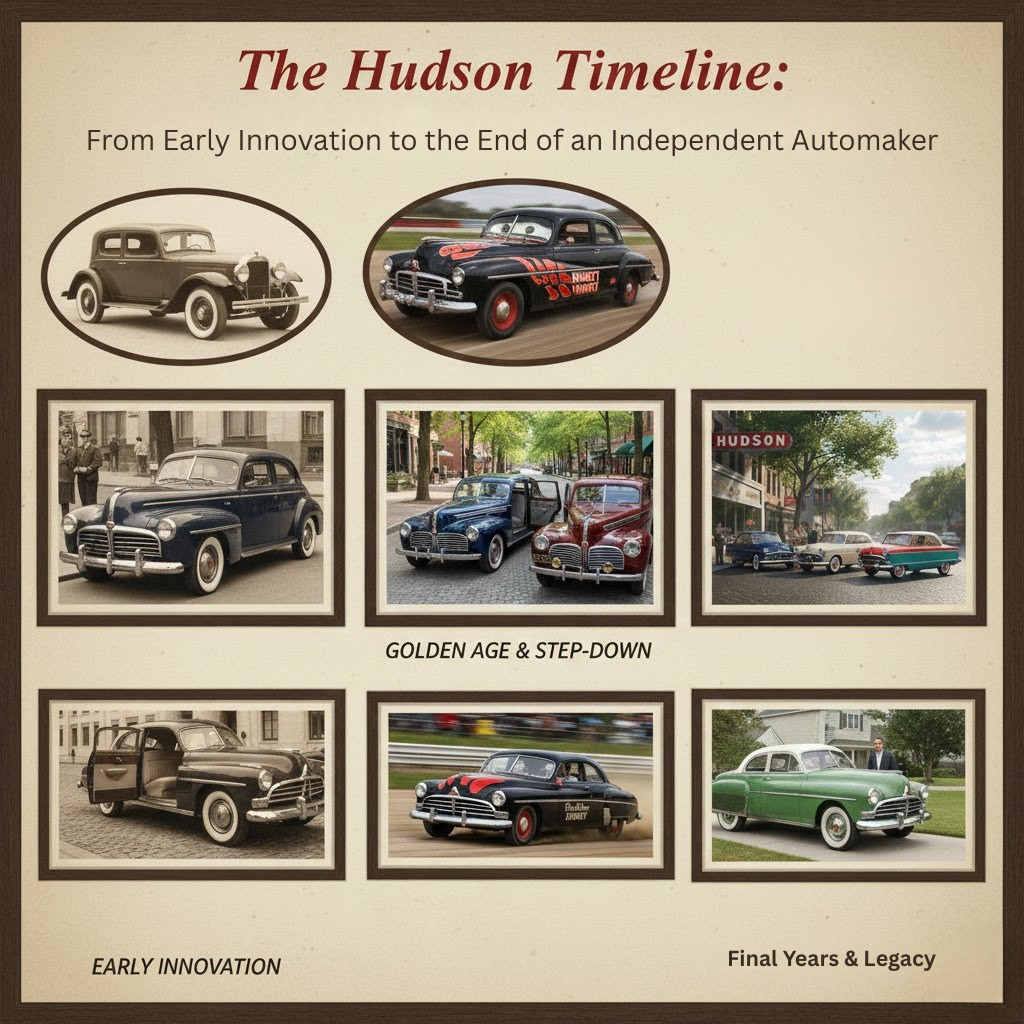
Hudson’s history is defined by innovation, independence, and a willingness to challenge convention. From the early success of the Super Six to the groundbreaking step-down cars of the postwar era, Hudson consistently demonstrated that smart engineering could compete with size and marketing power.
Today, Hudson cars are prized by collectors who appreciate their distinctive Hudson styling, performance heritage, and place in automotive history. While the Hudson name may no longer appear on new cars in the automotive industry, its influence and engineering excellence lives on through the enthusiasts who continue to preserve, restore, and celebrate one of America’s most inventive independent automakers.
Hudson’s story is one of innovation, independence, and quiet determination. From its earliest models to the revolutionary step-down cars, the company consistently found ways to stand apart in a rapidly changing automotive industry. Today, Hudson automobiles remain a reminder that some of the most interesting chapters in automotive history were written by independent makers willing to do things differently.
If you’re interested in exploring more classic car timelines, model histories, and automotive stories, we invite you to browse our archive and join the ongoing conversation with fellow enthusiasts.