
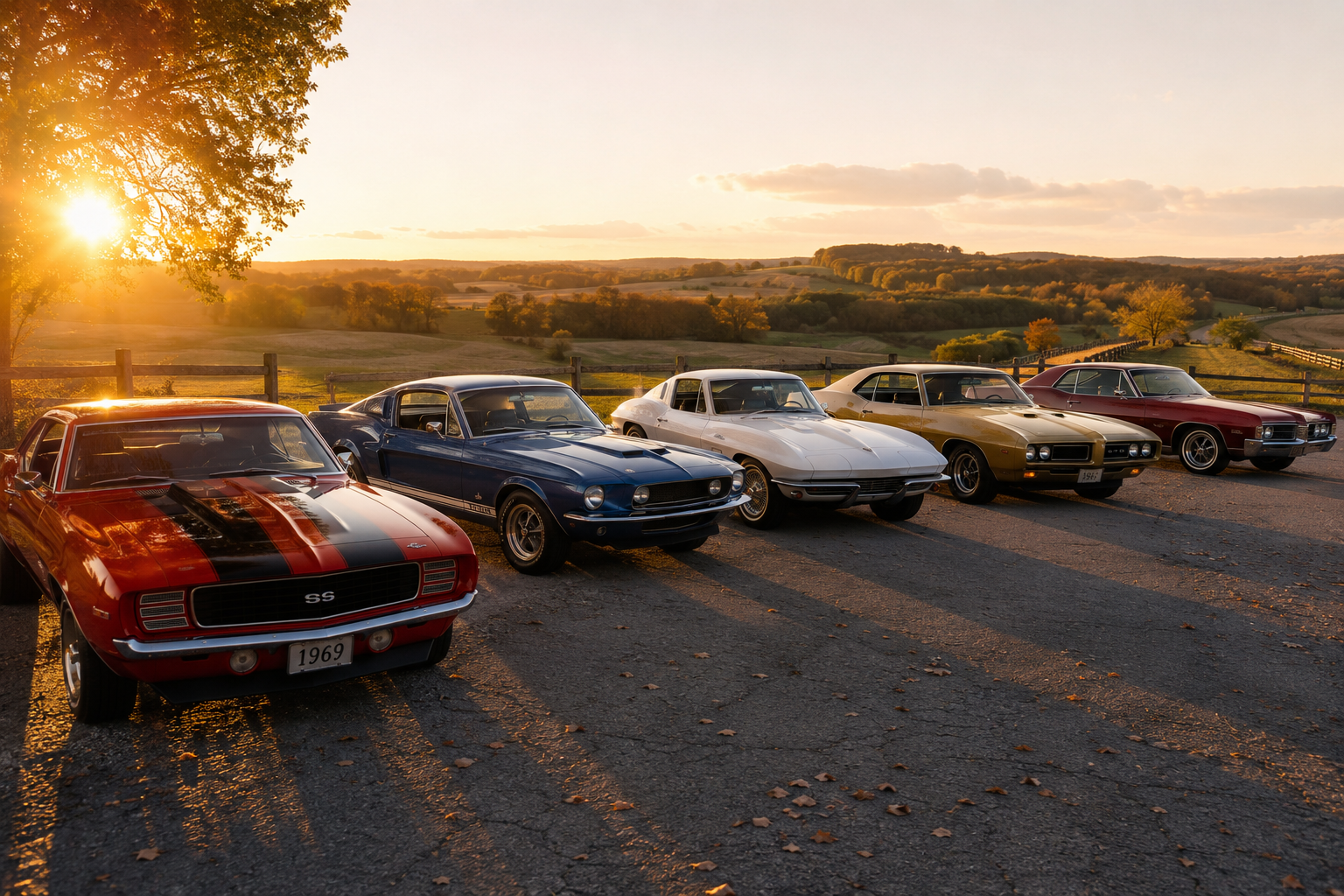
Somewhere out there is a guy who bought a 1969 Camaro SS for $3,200 and still has the receipt. If he held onto that car, it’s probably worth more than his first house. That’s the wild part about 1960s cars. A lot of them were built to be affordable and fun, not collectible. Nobody was thinking about resale value in 1967. They just wanted a car that looked good and went fast.
Fast forward almost sixty years and those same cars are some of the hottest names in the collector market. If you’ve got one sitting in a garage, or you’re thinking about buying one, here’s a rundown of the most collectible cars from the 1960s and what they tend to bring today.
1. Chevrolet Camaro SS/RS (1967-1969)
The first-generation Camaro is still one of the most requested classic cars on the market. The 1969 model, especially with the SS and RS package together, tends to bring the strongest money. Look for original big-block cars (396 or 427) since those hold value better than smaller engine options.
What it’s worth today: Nice driver-quality cars start in the $40,000-$60,000 range. Numbers-matching SS/RS convertibles with a big block can push well past $100,000.
What to look for: Cowl tag matches the VIN, original sheet metal (not a rust-repaired shell), and documentation if it’s a real SS or Z/28.
2. Ford Mustang Shelby GT350/GT500
Carroll Shelby took a good car and made it great. The GT350 and GT500 Mustangs are some of the most collected American cars, period. Early GT350s (1965-66) have a cult following, and the GT500 brought big-block muscle to the pony car world.
What it’s worth today: Standard Shelby Mustangs in good condition typically run $80,000-$150,000. Rare early cars and documented low-mileage originals can go much higher.
What to look for: Verify it through the Shelby American Automobile Club (SAAC). Clones are common, and a real Shelby needs paperwork to back it up.
3. Pontiac GTO (“The Judge”)
The GTO basically invented the muscle car category, and “The Judge” package from 1969-71 turned it into a full statement car with wild colors and a rear wing. It’s one of the most recognizable muscle cars from the era.
What it’s worth today: Standard GTOs in good shape run $30,000-$50,000. The Judge package adds a real premium, often pushing into the $70,000-$100,000+ range depending on options.
What to look for: Original Ram Air engines and documentation. A lot of regular GTOs have been “Judge-ified” over the years with reproduction parts.
4. Chevrolet Corvette Sting Ray (C2, 1963-1967)
The split-window 1963 coupe is one of the most iconic American car designs ever made. Chevy only built it that one year before switching to a single rear window, which makes it instantly recognizable and instantly desirable.
What it’s worth today: Regular C2 Corvettes run $50,000-$90,000 depending on engine and options. The 1963 split-window coupe alone commands a strong premium over other C2 years just for the styling.
What to look for: Numbers-matching drivetrain and original fiberglass body panels. Corvettes get restored heavily, so originality is what separates a good buy from an overpriced one.
5. Plymouth Road Runner / Barracuda
Plymouth built the Road Runner to be a no-frills muscle car for a reasonable price, and it worked. The Barracuda, especially the 1970-71 ‘Cuda with a big block, has become one of the most valuable Mopars around.
What it’s worth today: A solid Road Runner runs $35,000-$60,000. Hemi ‘Cuda convertibles are in a different league entirely, with documented examples selling for over $1 million at auction.
What to look for: Fender tag decoding is critical on Mopars. It tells you the original engine, color, and options, which matters a lot for value.
6. Dodge Charger R/T (1969)
Thanks to a certain orange car with a “01” on the doors, the 1969 Charger R/T is one of the most recognized muscle cars in pop culture. That recognition keeps demand strong even outside the die-hard Mopar crowd.
What it’s worth today: Good driver-quality R/Ts run $50,000-$80,000. Numbers-matching 440 or 426 Hemi cars go well beyond that.
What to look for: Reproduction bodies are common because of demand from the movie tie-in. Confirm it’s a real R/T, not a clone built to look like one.
7. Chevrolet Chevelle SS 396/454
The Chevelle SS gave Chevrolet a mid-size muscle car that could compete with anything on the road. The 1970 LS6 454 is considered one of the strongest factory muscle car engines ever built.
What it’s worth today: Standard SS 396 cars run $40,000-$65,000. LS6-equipped 1970 models are significantly rarer and more valuable, often into six figures.
What to look for: Cowl induction hood and correct build sheet. A lot of Chevelles have been “SS cloned” from base models.
8. Buick Riviera (1963-1965)
The first-generation Riviera doesn’t get talked about as much as the muscle cars on this list, but the styling holds up better than almost anything else from the decade. Clean, sharp lines with none of the chrome overload other cars leaned on. It was Buick’s answer to personal luxury coupes like the Thunderbird, and it still turns heads.
What it’s worth today: Good condition Rivieras run $25,000-$40,000, which makes it one of the more attainable entries on this list for the styling and history you get.
What to look for: Rust in the frame rails and floor pans, since these were built on a full frame and can hide corrosion issues. Original interior trim is hard to source, so an intact cabin adds real value.
9. Toyota 2000GT (1967-1970)
Toyota only built a little over 300 of these, and it’s one of the rarest, most valuable Japanese cars ever made. It showed the world that Japan could build a legitimate sports car to rival anything from Europe.
What it’s worth today: When one comes up for sale, which is rare, it can bring $500,000 to over $1 million depending on condition and history.
What to look for: Realistically, most people will never own one. If you’re researching this car, it’s more about appreciating the history than shopping for one.
10. AMC AMX (1968-1970)
The underdog on this list. AMC built the AMX as a two-seat muscle car to compete with the Corvette, and it never got the recognition it deserved. That’s actually good news if you want a real 1960s muscle car without spending six figures.
What it’s worth today: Good condition AMX cars run $25,000-$40,000, which makes it one of the most affordable ways into genuine muscle car ownership from this era.
What to look for: Because it’s less common, parts availability is tighter. Check that trim and glass are present, since those are the hardest pieces to replace.
Why 1960s Cars Keep Climbing in Value
A few things are driving this market. The generation that grew up wanting these cars now has the money to buy them. Movies and shows keep putting cars like the Charger and GTO back in front of new audiences. And there’s a hard ceiling on supply. Nobody is building more 1963 split-window Corvettes. Once the existing cars are gone or locked away in collections, that’s it.
If you’re thinking about buying, the best advice is the same as it’s always been. Buy the best condition car you can afford, get it inspected by someone who knows the specific model, and get the paperwork before you fall in love with the car.