
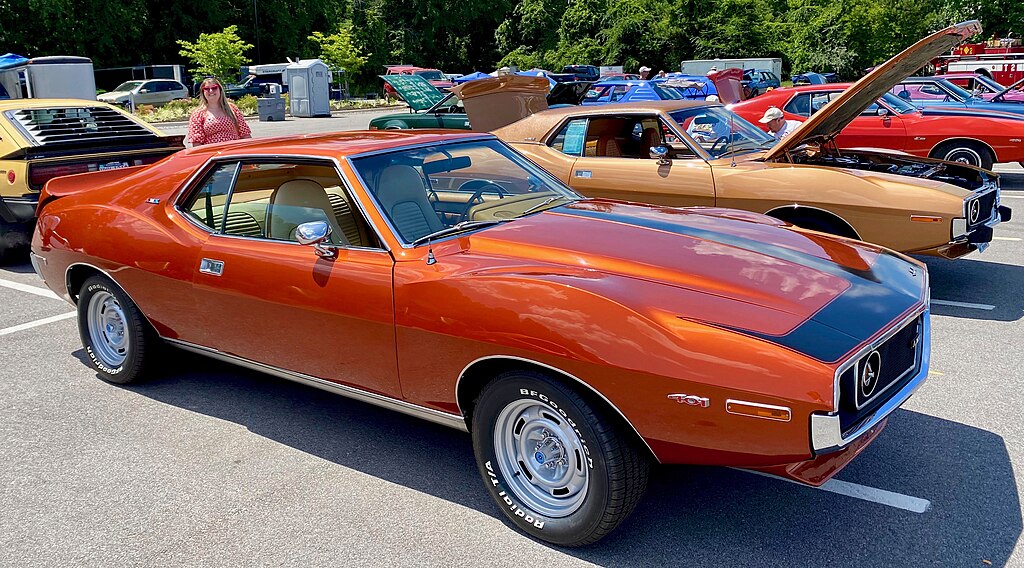
In a market increasingly dominated by skyrocketing prices for Mustangs, Camaros, and Challengers, savvy collectors are turning their attention to the often-overlooked AMC Javelin. This distinctive American muscle car, produced from 1971 to 1974, is experiencing a resurgence in the collector market as enthusiasts search for unique alternatives with strong investment potential.
What made the second generation Javelin’s design special?
The second-generation Javelin featured a bold, distinctive design that continues to turn heads today:
- Elongated hood with shortened rear deck creating a dramatic silhouette
- Pronounced “Coke bottle” fender flares giving it a muscular, aggressive stance
- Unique full-width grille making it instantly recognizable among muscle cars
- Aircraft-inspired cockpit with wraparound dashboard and driver-oriented controls
- Designed under the direction of AMC’s famed designer Dick Teague
- Distinctive styling that stands out at car shows compared to more common muscle cars
Automotive historians note that what makes the second-gen Javelin special is how it stands out in a crowd. In a sea of muscle cars that often blend together visually, the Javelin’s unique proportions and distinctive front end make it instantly recognizable among its contemporaries.
What engines and performance options were available in the 1971-1974 Javelin?
The Javelin backed up its aggressive styling with impressive performance capabilities:
- Engine options ranging from an economical 232 cubic inch inline-six to the powerful 401 cubic inch V8
- Top-spec 401 V8 produced 330 horsepower and impressive torque
- AMX package offered as a performance-oriented trim level rather than a separate model
- “Go Package” performance upgrades available for serious enthusiasts
- Enhanced suspension components on performance models
- Proven racing pedigree, with Javelins dominating SCCA Trans-Am series in 1971, 1972, and 1976
- Racing versions piloted by legends like Mark Donohue and George Follmer
Why are second generation Javelins increasing in value in 2025?
Market analysts point to several factors driving the current surge in Javelin values:
- Approximately 35% price increase over the past 18 months
- Relatively low production numbers with just over 100,000 second-generation models built
- Many examples lost to rust, accidents, or scrapping over the decades
- Final year of production in 1974 makes it one of the earliest casualties of the muscle car era
- Growing appreciation (increased demand) for unique styling as collectors seek alternatives to mainstream muscle cars
- Younger collectors entering the market with nostalgia for these distinctive vehicles
Market analysts point to a perfect storm of factors driving interest in these cars. When factoring in that many were lost to rust, accidents, or simply scrapped over the decades, surviving examples—especially in good condition — are genuinely rare in today’s market.
How much do second generation Javelins cost in today’s market?
While prices are rising, Javelins still represent relative value compared to period competitors:
- Concours-quality 1971 Javelin AMX with the 401 engine: $85,000-$95,000
- Driver-quality examples with smaller V8 engines: $30,000-$45,000
- Significantly more affordable than comparable Hemi ‘Cudas or Shelby Mustangs that command seven figures
- Prices climbing steadily, suggesting potential investment opportunity
- Special colors like “Big Bad Orange,” “Plum Crazy,” or “Trans Am Red” command premium prices
- Models with factory documentation and comprehensive service history sell for top dollar
What should buyers look for when purchasing a second-generation Javelin?
For collectors interested in adding a Javelin to their collection, experts recommend focusing on these key areas:
- Rust inspection is crucial, particularly in the rear wheel arches, floor pans, and cowl area
- Replacement body panels are increasingly difficult to source, making solid examples highly desirable
- Documentation including factory build sheets, original window stickers, and service history
- Most desirable configurations: 1971-1972 Javelin AMX with the “Go Package” and 401 V8
- Original drivetrain components significantly increase value
- Factory options like rear spoilers, hood scoops, and special interior packages add to collectibility
- Evidence of professional restoration work with attention to factory-correct details
What is the future outlook for second generation Javelin values?
The market trajectory suggests continued growth for these distinctive muscle cars:
- Increasing appreciation for unique American automotive design from this era
- Growing recognition of the Javelin’s combination of muscle car performance with European-influenced styling
- Younger collectors entering the market with different perspectives on what makes a desirable classic
- Diminishing supply of quality examples as fewer survive each year
- Rising prices of mainstream muscle cars pushing collectors to seek alternatives
- Increasing media coverage and presence at major auctions raising awareness
Industry experts suggest that what we’re witnessing is a reappraisal of American automotive design from this era. The second-gen Javelin represents a uniquely American approach to GT cars that combines muscle car performance with European-influenced styling elements. That distinctive character is what’s driving renewed appreciation among collectors and enthusiasts alike.
Classic Cars Online US provides market analysis and guides for collector car enthusiasts. This article is for informational purposes only and not intended as investment advice.
Join Our Community of Classic Car Enthusiasts
Are you passionate about classic American muscle cars like the AMC Javelin? Join our thriving Classic Cars for Sale Facebook group where you’ll connect with fellow enthusiasts, see rare vehicles before they hit the public market, and get expert advice on purchases, restorations, and valuations. Whether you’re looking to buy your first classic, sell a prized possession, or simply share your passion with like-minded collectors, our community welcomes you. Click here to visit “Classic Cars Online US: Classic Cars for Sale” on Facebook and then click “Join Group” today!