
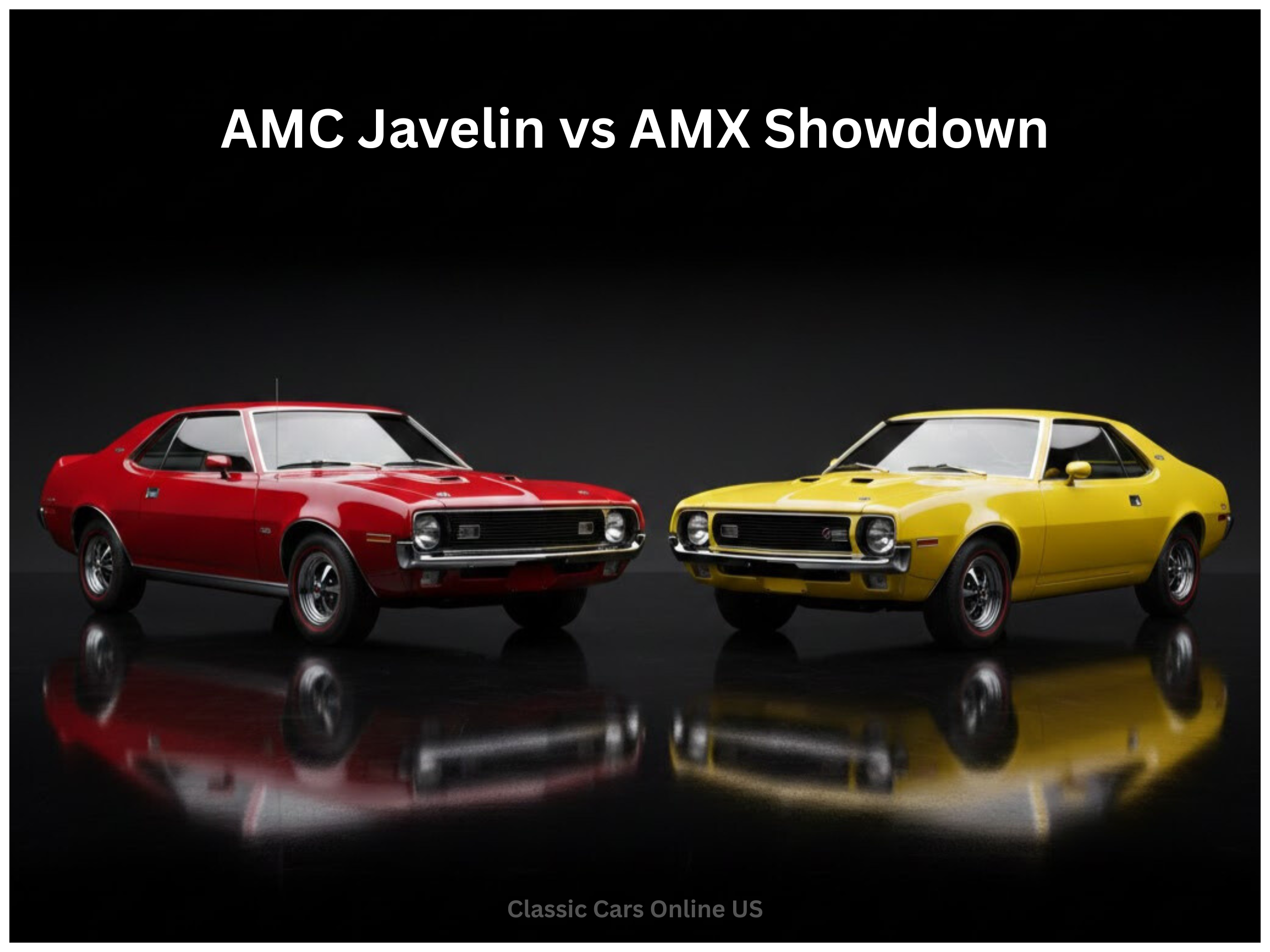
When American Motors Corporation decided to take on the Big Three automakers in the late 1960s, they didn’t just create one pony car — they created two distinctly different performance machines that would capture the imagination of enthusiasts for decades to come. The AMC Javelin and AMC AMX represented AMC’s bold answer to the Mustang, Camaro, and Barracuda, and while they shared muscle car DNA, these two American Motors creations took very different approaches to the muscle car formula.
In this comprehensive comparison, we’ll explore the key differences between these iconic AMC performance cars, dive into the specifications that made them muscle cars and racing heritage, and help you decide which one deserves a spot in your garage.
The Birth of AMC’s Pony Cars (1968)
American Motors Corporation was late to the pony car party, but when they finally arrived for the 1968 model year, they made quite an entrance. While Ford had been dominating the segment since 1964 with the Mustang, AMC wasn’t content to simply copy the competition. AMC positioned the Javelin and AMX against Detroit’s best — the Mustang, Camaro, and Dodge Challenger.
Under the direction of legendary designer Dick Teague, AMC developed a distinctive fastback design that would stand apart from the crowd. Teague’s team created flowing lines and aggressive proportions that gave both the Javelin and AMX a unique presence on the road. The design philosophy emphasized performance aesthetics without resorting to excessive chrome or gimmicky styling cues that plagued some competitors.
AMC positioned these cars as affordable alternatives to the Big Three’s offerings, targeting buyers who wanted performance, style, and value. The timing couldn’t have been better—the muscle car market was exploding, and AMC was ready to claim its share.
What is the Difference Between the Javelin and the AMX?
This is the question that confuses many classic car enthusiasts, and for good reason. While both cars shared the same basic platform and design language, they were fundamentally different vehicles targeting different buyers.
The AMC Javelin was a traditional pony car with 2+2 seating, meaning it had a usable back seat (however cramped) and four-passenger capability. Built on a 109-inch wheelbase, it was a practical performance car you could actually use for family duties if needed.
The AMC AMX, on the other hand, was something entirely different — a true two-seat sports car. Chrome letters spelling out AMX adorned the rear panel. AMC removed the back seat, shortened the wheelbase to 97 inches, and created one of only two American-built two-seater production cars of the era (the Corvette being the other). This 12-inch reduction in wheelbase gave the AMX dramatically different proportions and handling characteristics.
Think of it this way: the Javelin was AMC’s Mustang fighter, while the AMX was their Corvette challenger. Same family, completely different missions.
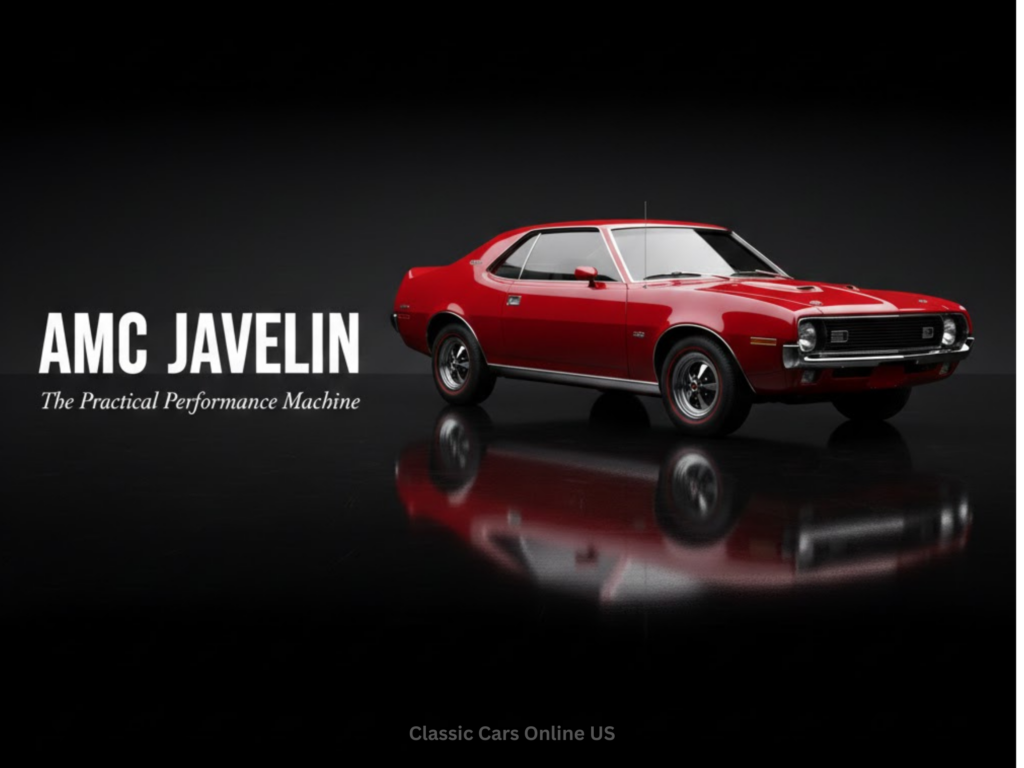
AMC Javelin: The Practical Performance Machine
Body and Design of These Muscle Cars
The 1968 AMC Javelin introduced a fastback roofline that was more dramatic than many competitors. With its 109-inch wheelbase and 2+2 seating configuration, the Javelin car offered genuine four-passenger capability—though rear-seat passengers needed to be friendly or flexible.
Dick Teague’s styling gave the Javelin distinctive character. The long hood, short deck proportions followed pony car convention, but details like the recessed grille, flowing side character lines, and available hood scoops gave it a unique identity. The interior was surprisingly spacious for a car of this type, with comfortable front bucket seats and instrumentation that emphasized the car’s performance mission.
Throughout its production run, the Javelin maintained clean, purposeful lines that have aged remarkably well. Whether you’re looking at a 1968 Javelin, 1970 AMC Javelin, or the redesigned 1971 AMC Javelin, each generation had strong visual presence.
Muscle Car Performance Options
AMC understood that muscle car buyers wanted choices like powerful engines, ram-induction hood, and alloy wheels. The American Motors Javelin could be ordered as mild or wild as your budget allowed.
Base Javelins came with inline-six engines, but the real action and muscle car performance came from the V8 options. The 290 cubic-inch V8 was the entry-level V8, producing a respectable 225 horsepower. Serious buyers opted for the 343 V8 with 280 hp, while the top-dog 390 V8 cranked out between 315 and 325 horsepower depending on the year and configuration. AMC’s V8s didn’t use the Mopar-style hemispherical combustion chambers but delivered competitive performance through clever engineering.
The Go Package, available from 1969 onward, transformed the Javelin into a legitimate muscle car. This package typically included the 390 V8, special handling suspension, power front disc brakes, Twin-Grip differential, and unique Go Package badging and graphics. A 1969 AMC Javelin with the Go Package was a formidable street machine.
Transmission choices included a three-speed manual, four-speed manual (including Hurst shifters on certain models), or Shift-Command three-speed automatic transmission. The four-speed was the enthusiast’s choice, offering precise gear selection and maximum control over that V8 power.
Racing Heritage
What really put the Javelin on the map was its unexpected success in Trans-Am racing. The Javelin’s dominance in SCCA T/A racing cemented AMC’s place in muscle-car history. When Roger Penske’s racing team, with driver Mark Donohue behind the wheel, chose the AMC car Javelin for the 1970 season, it shocked the racing establishment.
The 1970 Javelin Mark Donohue edition became legendary as Donohue and Penske delivered AMC’s first Trans-Am manufacturer’s championship. Factory Donohue production models are among the most collectible Javelins. The team won five races that season, and the success continued into 1971 with another championship. This racing pedigree gave the Javelin serious street credibility and proved that AMC could build a legitimate performance machine.
The Trans-Am success wasn’t just for show—the racing development improved the production cars. Handling upgrades, braking improvements, and suspension refinements filtered down from the track to the street, making later Javelins better drivers’ cars.
Why Was the AMC Javelin Discontinued?
By 1974, the muscle car era was effectively over. The oil crisis of 1973 sent gas prices soaring and buyers fleeing from thirsty V8s. Insurance companies had made high-performance cars prohibitively expensive for young buyers. New emissions regulations were strangling engine performance.
AMC faced these challenges from a weaker financial position than the Big Three. The company needed to focus resources on more profitable products. The 1974 AMC Javelin would be the last, as AMC shifted focus to compact cars and the emerging SUV market with vehicles like the Pacer and Cherokee.
It wasn’t that the Javelin failed—it simply fell victim to changing times and economic realities that killed most of the muscle car breed.
AMC AMX: The Two-Seat Muscle Machine

The Unique Formula
When AMC introduced the 1968 AMC AMX, they created something genuinely unique in the American automotive landscape. By chopping 12 inches out of the Javelin’s wheelbase and eliminating the back seat, AMC built a sports car that could legitimately compete with the Corvette — at least in concept.
The shorter 97-inch wheelbase gave the AMX car dramatically different proportions. It looked more aggressive, more purposeful, and frankly, more exciting than its four-seat sibling. The weight savings from removing the back seat and shortening the body improved the power-to-weight ratio, making the AMX quicker in a straight line and more responsive in corners.
Production 1968 AMX models came standard with V8 power—there was no six-cylinder option. This was a serious performance car from the start, and AMC priced it to compete directly with base Corvettes while offering comparable (or better) performance for less money.
Standard Performance
Unlike the Javelin, which could be ordered as a grocery-getter with a six-cylinder, every AMC AMX came with V8 power. Early models featured the 290 V8 as standard equipment, though most buyers opted for the 343 or 390 V8s.
The 1969 AMC AMX with the 390 V8 and Go Package was particularly potent, capable of running low-14-second quarter-mile times right off the showroom floor. The 390 produced 315 horsepower and a stump-pulling 425 lb-ft of torque—numbers that made the AMX a genuine muscle car threat.
Craig Breedlove, the land speed record holder, made headlines by setting 106 speed and endurance records at Goodyear’s test track in a specially prepared 1968 American Motors AMX. The car ran for days at speeds exceeding 140 mph, proving AMC’s performance credentials to a skeptical public.
Exclusivity Factor
While the Javelin sold in respectable numbers, the AMX remained relatively rare throughout its production run as a standalone two-seater (1968-1970). Total production of two-seat AMX models was only about 19,000 units across three years:
- 1968 AMX for sale listings are particularly rare, with only 6,725 produced
- 1969 AMX production reached 8,293 units
- 1970 AMX was the most popular with 4,116 built
This limited production makes original AMX for sale listings valuable finds today. The car’s unique two-seat configuration and sports car mission have given it strong collectibility, especially well-preserved examples with desirable options like the Go Package and four-speed manual transmission.
Head-to-Head Comparison
Performance Metrics
When comparing apples to apples—same year, same engine—the AMX held slight advantages due to its lighter weight and shorter wheelbase.
With the 390 V8:
- Javelin: 0-60 mph in approximately 6.6 seconds, quarter-mile in 14.8 seconds at 95 mph
- AMX: 0-60 mph in approximately 6.3 seconds, quarter-mile in 14.4 seconds at 98 mph
The differences weren’t huge, but the AMX’s weight advantage (about 200 pounds lighter) gave it a measurable edge in acceleration. Both cars topped out around 120 mph with the big-block 390.
Handling characteristics favored the AMX even more dramatically. The shorter wheelbase made it more maneuverable and responsive to steering inputs. The better weight distribution (thanks to removing the back seat and associated structure) helped the AMX feel more balanced in corners.
Design and Styling
Externally, the differences were obvious from any angle. The AMX’s abbreviated body gave it a more aggressive, purposeful stance. Both cars shared the same front-end styling, but the AMX’s shorter passenger compartment and faster roofline created distinctly different proportions.
Interior appointments were similar, though the AMX offered a slightly more focused, driver-oriented cockpit. Without a back seat, the AMX provided more luggage space behind the front seats, though total cargo volume was actually less than the Javelin.
Color and option availability was generous for both cars. AMC offered wild colors like Big Bad Orange, Big Bad Blue, and Big Bad Green — bold hues that looked fantastic on either body style and two-tone paint. Chrome bumpers, available hood scoops, and various stripe packages allowed buyers to customize their cars’ appearance.
Practicality vs. Purity
This is where the two cars diverged most significantly. The Javelin automobile was a practical choice—you could carry four people (two comfortably), had a usable trunk, and could serve as an only car if necessary. Insurance companies looked at it as a sporty car but not necessarily a pure muscle machine, sometimes resulting in lower premiums.
The AMX vehicle, with its two-seat configuration, made different compromises. It was a weekend toy, a second car, a statement. Insurance was often higher because there was no pretending this was anything but a performance machine. Fuel economy? Both cars were thirsty with the big V8s, typically returning 10-12 mpg in spirited driving.
For daily driving, the Javelin made more sense. For pure driving excitement and collectibility, the AMX had the edge.
Evolution Through the Years
The AMC Javelin AMX trim blended the performance image of the original AMX with the practicality of the Javelin body style.
First Generation (1968-1970)
The original 1968 AMC Javelin and AMX established the formula. These cars featured smooth, flowing lines and represented Dick Teague’s original vision. The 1969 American Motors Javelin received minor updates including revised badging and trim, while the 1970 American Motors Javelin got a more aggressive grille and refined interior.
The two-seat AMX remained largely unchanged through these years, with detail refinements each year. The 1970 AMC AMX for sale today are often the most desirable of the first generation, as AMC had worked out early production issues and performance was at its peak.
Second Generation Javelin (1971-1974)
The 1971 AMC Javelin introduced a completely redesigned body with more angular styling, longer dimensions, and increased interior room. This generation looked more contemporary and aggressive, though some enthusiasts prefer the original’s flowing lines.
Performance options continued, though power ratings began declining due to emissions regulations. The 1972 AMC Javelin, 1973 AMC Javelin, and final 1974 AMC Javelin all carried the redesigned styling with minor year-to-year updates.
AMX Transition to Javelin Trim Level (1971+)
Starting in 1971, the AMX name became a performance trim level on the Javelin rather than a standalone model. The 1971 Javelin AMX, 1972 AMX, and subsequent years were all four-seat Javelins with AMX performance packages—quite different from the original two-seat concept.
These later AMC Javelin AMX models offered strong performance and are more affordable today than original two-seat AMX models, making them attractive options for enthusiasts on a budget.
Most Desirable Model Years
For Javelin collectors:
- 1970 AMC Javelin Mark Donohue Edition (Trans-Am championship connection). The limited-edition Javelin SST Donohue commemorated AMC’s Trans-Am victories.
- 1969 AMC Javelin with Go Package (peak first-generation performance)
- 1971 AMC Javelin AMX (first year of redesign, strong performance)
For AMX collectors:
- 1969 AMX for sale listings with 390 and Go Package (peak performance year)
- 1968 AMX first-year model (historical significance, lowest production)
- 1970 AMC AMX (refined package, most produced year)
Market Values and Collectibility Today
The classic car market has been kind to both models, though AMX values typically run higher due to rarity and unique two-seat configuration.
Current Market Ranges (condition-dependent):
AMC Javelin:
- Driver-quality examples: $15,000-$25,000
- Excellent condition: $30,000-$45,000
- Show-quality, documented cars: $50,000-$75,000+
- Mark Donohue replicas/tributes: $40,000-$60,000
AMC AMX (two-seat models):
- Driver-quality examples: $25,000-$40,000
- Excellent condition: $45,000-$65,000
- Show-quality, documented cars: $70,000-$100,000+
- Rare options/low-mileage: $100,000+
The market favors cars with original engines, desirable options (Go Package, 390 V8, four-speed manual), and documented history. Restoration costs can be significant—budget $40,000-$80,000 for a complete professional restoration depending on starting condition.
Rarity Factors Affecting Value:
- Two-seat AMX models command premium over Javelin
- Go Package cars worth 20-30% more than standard models
- 390 V8 adds value over smaller engines
- Four-speed manual preferred over the automatic transmission
- Original, numbers-matching cars bring top dollar
- Special editions and unique colors increase value
Investment Potential: Both models have shown steady appreciation, with AMX values climbing faster. As muscle car prices moderate, these overlooked AMC products represent potential value plays compared to more expensive GM, Ford, and Mopar equivalents.
Which One Should You Choose?
Javelin Advantages: Practicality, Racing Heritage, Availability
The Javelin car for sale listings are more common, giving buyers more selection. You can actually use a Javelin as a weekend driver without compromises—bring friends, haul groceries, drive cross-country if you want. The Trans-Am racing connection gives the Javelin genuine performance credibility.
Parts availability is decent, with many components shared across AMC’s product line. The active AMC community means restoration parts and expertise are available. Lower entry prices mean you can get into Javelin ownership with a smaller investment.
AMX Advantages: Exclusivity, Performance, Two-Seat Character
The AMC AMX for sale finds are rare and special. You’re buying into exclusivity—most car shows won’t have another one present. The two-seat configuration is genuinely unusual for American cars, making the AMX a conversation starter everywhere you go.
Performance is slightly better due to lighter weight and superior handling. The shorter wheelbase creates a more engaging driving experience. From a collector standpoint, the AMX’s rarity and unique character position it for stronger long-term appreciation.
Considerations for Collectors vs. Drivers
If you’re a collector seeking investment potential and show recognition, the AMX is the better choice. Its rarity, unique configuration, and growing collector interest suggest stronger appreciation potential.
If you’re a driver who wants to actually use your classic car regularly, the Javelin makes more sense. It’s more practical, parts are easier to find, entry costs are lower, and you won’t feel guilty about putting miles on it.
How Do Suspension and Handling Characteristics Differ Between the AMC Javelin and AMX During a Competitive Showdown?
The 12-inch wheelbase difference creates dramatic handling distinctions. The AMX’s shorter wheelbase makes it more responsive to steering inputs and better balanced through corners. The weight reduction (approximately 200 pounds) improves the power-to-weight ratio and reduces unsprung weight.
Both cars used similar front suspension designs (upper and lower A-arms with coil springs) and rear leaf springs, but the AMX’s geometry benefited from the shorter platform. In period road tests, reviewers consistently noted the AMX felt more nimble and connected to the road, while the Javelin delivered slightly more stable highway cruising.
With the Go Package suspension upgrades (heavy-duty springs, larger sway bars, stiffer shocks), both cars handled well for their era, though neither could match the pure handling prowess of contemporary Corvettes or European sports cars. For American muscle of the period, they were competitive performers.
Parts Availability and Restoration Costs
A verified build sheet adds significant value to any AMC Javelin or AMX restoration. Parts availability is moderate for both models. While not as plentiful as Mustang or Camaro parts, the active AMC enthusiast community maintains good resources:
Available Parts:
- Engine components (shared with other AMC V8s)
- Suspension and brake parts
- Weather sealing and rubber components
- Interior restoration materials
- Body panels (some reproduction, some NOS)
Challenging Parts:
- Unique trim pieces
- AMX-specific body panels
- Original upholstery patterns
- Rare option components (Go Package badges, special wheels)
Restoration costs are comparable to other American muscle cars, though finding experienced AMC restorers may require more searching. Budget accordingly:
- Mechanical restoration: $15,000-$30,000
- Paint and bodywork: $10,000-$25,000
- Interior restoration: $5,000-$15,000
- Chrome and trim: $3,000-$8,000
Conclusion
The AMC Javelin and AMX represent American Motors’ finest hour in performance car development. The Javelin delivered practicality and racing credibility wrapped in distinctive Dick Teague styling, while the AMX offered genuine two-seat sports car exclusivity that rivaled the Corvette.
Both cars have earned their place in muscle car history. The Javelin’s Trans-Am championships proved AMC could beat the Big Three on the track, while the AMX’s unique character made it one of the most distinctive American performance cars ever built.
These underappreciated American classics offer strong value propositions compared to more expensive alternatives. Whether you choose the practical Javelin auto or the exclusive AMX car, you’re buying into a piece of automotive history that represents everything great about American performance cars—bold styling, V8 power, and the underdog spirit of a company willing to challenge the establishment.
The choice between them ultimately comes down to your priorities. Want practicality and racing heritage? The Javelin is calling. Want exclusivity and pure driving excitement? The AMX is your answer. Either way, you can’t go wrong with these distinctive AMC muscle machines.
Ready to find your dream AMC? Check out available listings for Javelin cars for sale and AMX cars for sale today, and join the passionate community of AMC enthusiasts who appreciate these overlooked American classics.
FAQs: AMC Javelin vs AMX
Q: What years was the two-seat AMX produced?
A: The AMC AMX was produced as a standalone two-seat model from 1968-1970. After 1970, the AMX name became a performance trim package on the four-seat Javelin through 1974.
Q: How many two-seat AMX models were built?
A: Approximately 19,134 two-seat AMX models were produced: 6,725 in 1968, 8,293 in 1969, and 4,116 in 1970.
Q: What’s the most powerful engine available in the Javelin and AMX?
A: The 390 cubic-inch V8 was the most powerful option, producing 315-325 horsepower depending on year and configuration. This engine was available in both Javelin and AMX models.
Q: Did the AMC Javelin really beat Mustangs and Camaros in Trans-Am racing?
A: Yes! With driver Mark Donohue and team owner Roger Penske, the Javelin won the Trans-Am manufacturer’s championship in both 1970 and 1971, defeating Ford, Chevrolet, and other competitors.
Q: Are AMC Javelin and AMX parts still available?
A: Yes, though availability varies. Many mechanical parts are shared with other AMC vehicles and remain available. Body-specific trim and interior parts are more challenging but can be found through specialized AMC parts suppliers and the enthusiast community.
Q: Which is more valuable, a Javelin or an AMX?
A: Original two-seat AMX models typically command higher prices due to their rarity and unique two-seat configuration, often selling for 50-70% more than comparable Javelins.
Q: Can I daily drive an AMC Javelin or AMX?
A: While possible, especially with a Javelin, both cars are 50+ years old and lack modern safety features, fuel efficiency, and reliability. Most owners treat them as weekend drivers or special occasion vehicles.
Q: What’s the difference between a 1970 AMX and a 1971 AMX?
A: The 1970 AMX is a two-seat standalone model. The 1971 AMX is a four-seat Javelin with the AMX performance package—completely different vehicles despite sharing the AMX name.
Additional Resources
Production Numbers by Year
| Model | 1968 | 1969 | 1970 | 1971 | 1972 | 1973 | 1974 |
|---|---|---|---|---|---|---|---|
| Javelin | 55,124 | 40,675 | 28,210 | 23,455 | 26,184 | 22,150 | 18,799 |
| AMX (2-seat) | 6,725 | 8,293 | 4,116 | – | – | – | – |
| Javelin-AMX (4-seat) | – | – | – | 2,054 | 3,220 | 4,635 | 4,980 |
Performance Specifications
| Specification | Javelin (390 V8) | AMX (390 V8) |
|---|---|---|
| Horsepower | 315 hp @ 4600 rpm | 315 hp @ 4600 rpm |
| Torque | 425 lb-ft @ 3200 rpm | 425 lb-ft @ 3200 rpm |
| 0-60 mph | 6.6 seconds | 6.3 seconds |
| Quarter Mile | 14.8 @ 95 mph | 14.4 @ 98 mph |
| Top Speed | ~120 mph | ~120 mph |
| Wheelbase | 109 inches | 97 inches |
| Weight | ~3,400 lbs | ~3,200 lbs |
Notable Special Editions
Javelin:
- Trans-Am Victory models (1970-1971)
- Mark Donohue Edition (1970)
- Pierre Cardin Edition (1972)
- Go Package models (1969-1974)
AMX:
- Craig Breedlove Record Car (1968)
- Big Bad Color editions (1969-1970)
- Go Package models (all years)
AMC Enthusiast Clubs and Resources
- AMC Rambler Club (AMCRC): National organization for all AMC vehicles
- AMC Forum: Active online community at various AMC-dedicated websites
- AMO (AMC Owners Association): Publishes magazine and hosts national events
- Classic AMC Magazine: Print and digital resource for enthusiasts
- Specialty Parts Suppliers: Kennedy American, AMC Lives, and various independent suppliers
Whether you’re searching for a 1968 Javelin for sale, a 1969 AMX for sale, or any other year and model or AMC parts and accessories, these resources will help you find, restore, and maintain your piece of AMC performance history. Disclosure: Some of the links in this section are affiliate links. As an eBay Partner, Classic Cars Online US may earn a commission if you make a purchase through these links.