
The 1959 Ford F100 is one of the most historically significant classic trucks, marking the first year of Ford’s factory 4×4 system. In this guide, we break down specs, history, value, and what makes this model stand out today.
The 1959 Ford F100 pickup truck represents more than just another late-1950s pickup. It marks a pivotal moment in Ford truck history. For the first time, the company started by Henry Ford produced its own factory 4-wheel-drive F-Series trucks instead of relying on outside conversion companies. That shift changed the trajectory of Ford Motor Company’s truck development and helped shape the lineage that would eventually lead to today’s dominant F-Series models
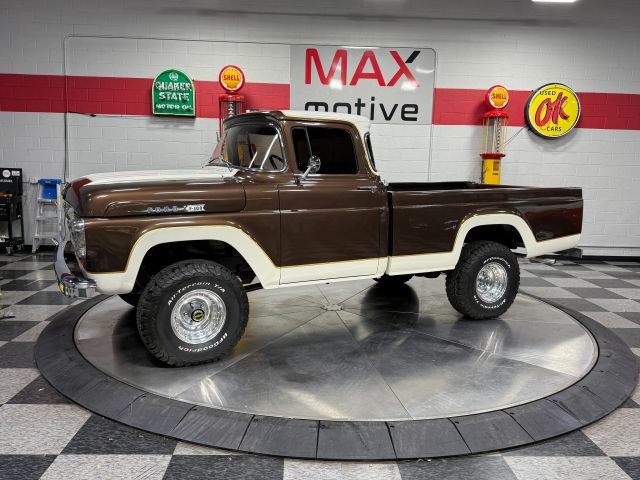
This restored 1959 Ford F100 4×4 pickup truck, presented by MAXmotive, offers a strong visual example of how these Ford Era trucks combined workhorse durability with unmistakable mid-century style.
The 1957–1960 “Styleside” Era
The 1959 model falls within the third-generation Ford F-Series redesign, introduced in 1957. This generation brought a more modern, integrated look. Instead of the earlier separate fender appearance, Ford Motor Company adopted a cleaner body line that flowed from cab to bed, especially in the Styleside configuration.
By 1959, the front end had evolved into a distinct quad-headlight setup with a wide chrome grille. The look was bold and symmetrical. It gave the Ford F-Series truck a broader, more confident stance compared to the earlier single-headlight designs.
The hood emblem, grille pattern, and chrome bumper details reflect the design language of the era. There is visual weight in the front fascia. It feels substantial. Even parked, the truck looks planted.
The two-tone brown and white finish on this example highlights those design lines. The contrast emphasizes the fender arches and body contours in a way that feels period-correct yet eye-catching.
1959: The Factory 4×4 Milestone
Before 1959, Ford pickup trucks equipped with four-wheel drive were typically converted by outside companies such as Marmon-Herrington. While those conversions were functional, they were not produced directly by Ford.
In 1959, Ford Motor Company brought 4-wheel-drive production in-house for the F-Series. That decision signaled confidence. It showed Ford was serious about competing in the growing utility and off-road truck segment.
This move laid the groundwork for decades of 4WD technology development in heavy-duty and off-road pickup trucks. The importance of that shift becomes clearer when viewed in hindsight. The factory 4×4 F100 stands at the beginning of a lineage that would eventually include some of the most successful truck platforms in automotive history.
Owning a 1959 factory 4×4 means owning a first-year production milestone. Collectors often place additional value on first-year engineering transitions like early 4WD technology, and this truck sits squarely in that category.
The 223 Cubic Inch Inline Six

Powering many 1959 F100 models was the dependable 223 cubic inch inline six-cylinder engine. Known for durability and torque at lower RPM ranges, the 223 was well suited for work applications. It was not flashy, but it was reliable.
The inline-six configuration provided smooth operation and practical pulling power. For farmers, contractors, and utility operators in the late 1950s, that mattered more than raw horsepower numbers.
This particular pickup truck retains the 223 inline six but incorporates a modern enhancement: Holley Sniper fuel injection. The addition of electronic fuel injection improves cold starts, idle stability, and overall drivability without sacrificing the character of the original powerplant.
For many enthusiasts, this balance is appealing. The truck keeps its period-correct engine architecture while benefiting from modern reliability upgrades. It reflects a broader collector trend toward usability rather than strict originality.
Manual Transmission and Mechanical Engagement
The manual transmission with floor shifter reinforces the truck’s hands-on driving experience. There is no insulation from the mechanics. You feel the shift points. You hear the engine respond. You control the pace.
That direct engagement is part of the appeal of vintage trucks. It connects the driver to the machine in a way modern vehicles often filter out.
For collectors who like to drive their vehicles rather than store them, this setup keeps the experience authentic.
Interior: Utility Roots with Custom Craftsmanship

The original 1959 Ford F-100 interior was built with function in mind. Painted metal dash surfaces, simple gauges, and a wide bench seat reflected its purpose as a work tool.
This restored example takes a creative approach to that foundation. The custom deer hide bench seat and matching deer hide side panels introduce texture and warmth to the cabin. The upholstery gives the truck a rustic feel that complements its 4×4 heritage.
It is not overbuilt or overly modernized. The custom elements still feel aligned with the truck’s identity. The dashboard retains its vintage character, while subtle upgrades improve usability.
The result is a cabin that respects history but feels personalized.
Suspension, Axles, and Off-Road Presence

Factory 4×4 Ford F-100 models relied on solid axles and leaf spring suspension, engineered for durability and load capacity. These trucks were designed to handle uneven terrain and demanding work conditions.
This example rides on 15-inch wheels wrapped in 33-inch BFGoodrich All-Terrain tires. The aggressive tire profile enhances the truck’s stance while remaining consistent with its utility mission.
Monroe OESpectrum shocks contribute to a smoother ride without compromising rugged capability. Underneath, the hardware reflects careful restoration work. The components appear clean and well maintained, reinforcing the truck’s turnkey status.
The combination of factory 4WD architecture and thoughtful suspension updates makes the truck both capable and visually commanding.
Design Details That Define the Era

The quad headlights, wide chrome grille, and hood emblem are unmistakably late-1950s Ford. The body lines are straightforward but strong. There is very little excess ornamentation.
The bed remains clean and functional, protected by a durable bedliner. The tailgate’s bold “FORD” stamping reinforces the brand identity without unnecessary embellishment.
Even the gold leaf pinstriping on this example nods to classic customization trends while staying restrained. It adds visual interest without overpowering the truck’s core design.
1959 Ford F100 4×4 Specs at a Glance
- Engine: 223 cubic inch inline six
- Fuel System (this example): Holley Sniper electronic fuel injection
- Transmission: Manual with floor shifter
- Drivetrain: Factory 4-wheel drive
- Suspension: Solid axle with leaf springs
- Wheels: 15-inch
- Tires: 33-inch BFGoodrich All-Terrain
- Production significance: First year of Ford in-house factory 4WD
Investment Outlook: The 1959 F100 4×4 Models Today
Interest in 1950s American trucks has steadily grown. As muscle cars continue to command high prices, many collectors have shifted attention toward vintage pickups. They offer historical appeal, visual character, and often lower entry points compared to high-profile performance cars.
Within that segment, factory 4×4 models tend to draw additional interest. The 1959 first-year production of the Ford F-100 milestone adds another layer of collectibility.
Inline-six trucks often trade at slightly different price points compared to V8-equipped examples, but condition and originality play a larger role than engine count alone. Well-restored or tastefully updated trucks, especially those with documented factory 4WD, typically maintain strong demand.
The market increasingly favors vehicles that can be driven comfortably. Upgrades such as electronic fuel injection and improved shocks align with that preference.
From an investment perspective, the 1959 Ford F100 factory 4×4 occupies a meaningful niche: historically significant, visually distinctive, and practical enough to enjoy.
A Representative Example of a Historic Model

The restored brown and white 1959 Ford F100 4×4 presented by MAXmotive provides a clear demonstration of what makes these trucks compelling. It blends factory significance with careful updates and craftsmanship.
By combining period design, first-year factory 4WD production, and modern drivability enhancements, it captures the broader appeal of the model itself.
For enthusiasts researching the 1959 Ford F100, this example offers a strong visual reference point for how these trucks can be preserved, upgraded, and presented today.
Frequently Asked Questions About the 1959 Ford F100
1️⃣ Was 1959 the first year Ford offered factory 4-wheel drive?
Yes. 1959 marked the first year Ford produced factory 4-wheel-drive F-Series trucks in-house rather than relying on outside conversion companies such as Marmon-Herrington. While four-wheel-drive Ford trucks existed before 1959, they were typically converted after leaving the factory. The 1959 F100 factory 4×4 represents a significant milestone in Ford truck development.
2️⃣ What engine came in a 1959 Ford F100?
The 1959 Ford F100 was available with several engine options, including inline six-cylinder and V8 configurations. One of the most common engines was the 223 cubic inch inline six, known for durability and dependable low-end torque. Many collectors appreciate the 223 for its reliability and period-correct character, especially in factory 4×4 trucks.
3️⃣ How much is a 1959 Ford F100 worth today?
Values vary depending on condition, originality, drivetrain, and documentation. Well-restored 1959 Ford F100 trucks typically command stronger prices than unrestored examples, particularly if they are factory 4-wheel-drive models. Inline six trucks may trade differently than V8-equipped versions, but overall condition and restoration quality often influence value more than engine configuration alone. First-year factory 4×4 models tend to draw additional collector interest.
4️⃣ Is the 223 inline six reliable?
The 223 cubic inch inline six is widely regarded as a durable and long-lasting engine when properly maintained. Its simple design and torque-focused performance made it well suited for work applications in the late 1950s. Many enthusiasts consider it a dependable powerplant, especially when upgraded with modern fuel delivery systems for improved drivability.
(Images of this beautiful Ford pickup used with permission from MAXmotive. Visit the eBay listing for additional details.)