
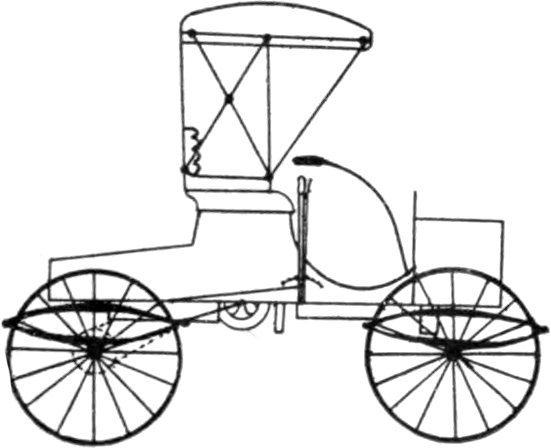
The 1907 Albany Run-a-bout Model 3 looks almost exactly like the Model 2, and the directory even uses the same drawing for both. The difference is under the body. For $50 more than the Model 2’s $300, the Model 3 gave you a second cylinder and a top speed that doubled to 20 miles per hour.
Free download: Color your own Albany. After you’ve read about the Model 3, you can try it with a pencil. I made a free coloring page of an Albany Run-a-bout out on a country road, with room to pick your own paint colors and a row of circles to keep track of the ones you use. It prints on regular letter-size paper and works best with colored pencils or crayons.
What Changed From the Model 2
If you read my piece on the Albany Model 2, here’s how the two compare:
| Model 2 | Model 3 | |
|---|---|---|
| Price | $300 with top | $350 |
| Horsepower | 4–6 H.P. | 8–10 H.P. |
| Cylinders | 1 | 2 |
| Bore × stroke | 4½ × 4 in. | 4 × 4¼ in. |
| Weight | 500 lbs | 550 lbs |
| Speeds | 2 to 10 mph + reverse | 2 to 20 mph + reverse |
Everything else carries over: the piano-box body, the 62-inch wheelbase, the solid tires, the tiller, the water cooling with a pump, and the friction transmission.
By my own math, those two cylinders add up to roughly 107 cubic inches, about 1.75 liters, compared with about 64 cubic inches for the Model 2’s single cylinder.
How It Would Have Driven
Like the Model 2, the Model 3 used a friction transmission, where a disk slides across a wheel to change speed. You’d move the side lever and slide through the range anywhere from a crawl to about 20 miles an hour, with no fixed gears to find.
With the extra cylinder, the engine would probably have pulled better on hills and run more smoothly than a single, which was a real advantage on rutted farm roads.
Twenty miles an hour sounds modest now. On a dirt road in a 550-pound buggy with solid tires and a tiller for steering, it would have felt plenty quick. The brake still acted on the transmission, so stopping at the top of the range took planning.
(Please note: This section is an imagined drive based on the specs, not a period road test.)
Full Specifications (1907 Model 3, 8–10 H.P.)
- Price: $350
- Body: Piano box
- Seats: 2 persons
- Weight: 550 pounds
- Wheelbase: 62 inches
- Tread: 52 inches
- Tires, front: 30 × 1¼ in., solid
- Tires, rear: 32 × 1¼ in., solid
- Steering: Hand lever or tiller
- Brakes: Foot brake on transmission
- Springs: Full elliptic
- Frame: Angle steel
- Bore and stroke: 4 in. × 4¼ in.
- Cylinders: 2, in front
- Valves: 3 port
- Motor suspension: Side members of frame
- Cooling: Water; pump
- Ignition: Jump spark
- Current supply: Dry battery
- Carbureter: Automatic
- Lubrication: Sight feed pressure
- Motor control: Spark and throttle
- Change gear: Friction type
- Speeds: 2 to 20 miles and reverse
- Change-gear control: Sidelever
- Drive: Center chain
A Note on the Engine
As with the Model 2, sources disagree. The 1907 directory lists this model with two water-cooled cylinders mounted in front. Some modern references describe the Albany as air-cooled, and a 1908 Albany ad promotes a 16–18 H.P. air-cooled motor. The likeliest explanation is that the design changed from year to year, but I couldn’t confirm that, so these specs follow the 1907 directory.