
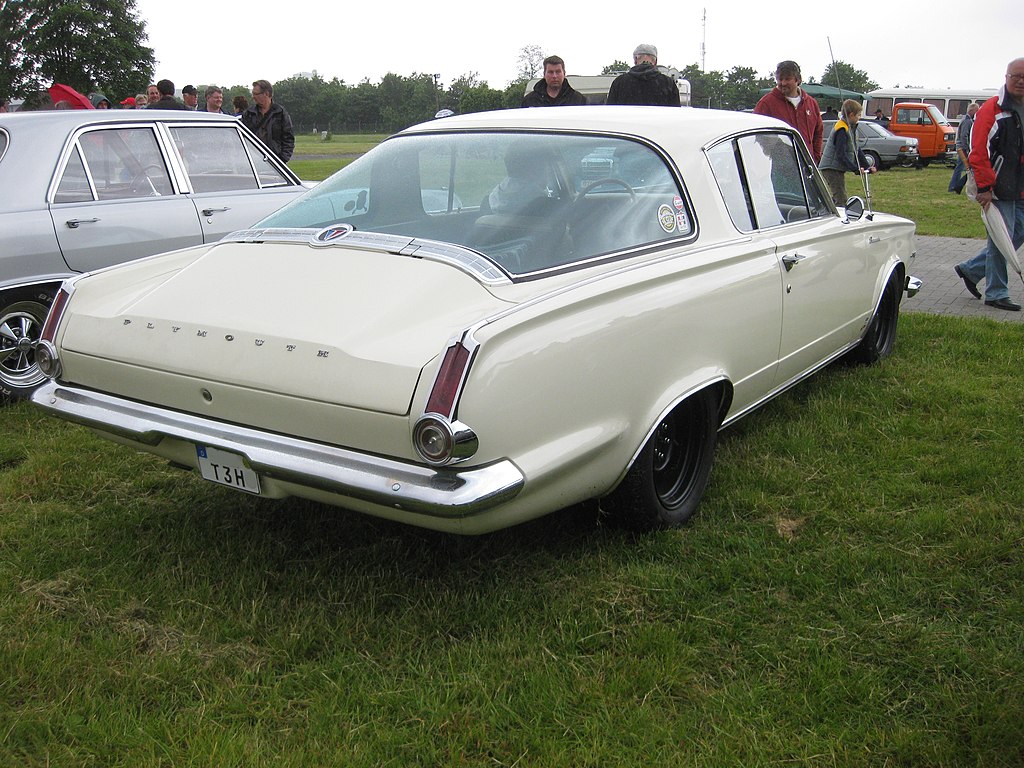
When Plymouth unveiled the first Barracuda on April 1, 1964, they couldn’t have known they were introducing what would eventually become one of America’s most collectible muscle cars. Beating the Ford Mustang to market by just two weeks, the original Barracuda offered a unique proposition in the emerging “pony car” segment: a sporty fastback built on Plymouth’s reliable Valiant platform, distinguished by its enormous, curved rear window.
The Unmistakable Silhouette of Detroit’s Distinctive Fastback Pioneer
The most distinctive feature of the first-generation Barracuda was undoubtedly its massive rear window. At 14.4 square feet, this wraparound glass panel was the largest ever installed on a production car at the time. It created a sleek fastback profile that made the Barracuda instantly recognizable on the road, while flooding the interior with light and offering exceptional visibility — though with the trade-off of turning the rear compartment into something of a greenhouse on sunny days.
A Personal ’64 Barracuda Memory: Through a Child’s Eyes
I still have vivid memories of riding in the back seat of my mom’s ’64 Barracuda as a very young child. What captivated me most wasn’t the engine’s rumble or the car’s speed, but that enormous curved rear window. Lying back and looking up — children’s car safety seats weren’t a thing yet back then — I’d watch as trees and telephone poles whizzed by, their shapes bending and distorting through the curved glass like something from a funhouse mirror. The world outside seemed to warp and flow in a mesmerizing display that no other car could replicate. On summer drives, that back seat became my own private planetarium — hot as blazes, even with the breeze from the open windows — but magical nonetheless.
Performance and Powertrains
While the first Barracudas shared much with the humble Valiant, Plymouth ensured they had enough performance credentials to justify their sporty appearance:
- Base models came with the 225 cubic inch “Slant Six” producing 145 horsepower
- Optional 273 cubic inch V8 initially offered 180 horsepower
- 1965 saw the introduction of the “Commando” version of the 273 V8, featuring:
- Four-barrel carburetor
- Higher compression ratio
- More aggressive camshaft
- Total output of 235 horsepower
- The Formula S package added performance-tuned suspension, larger wheels, and enhanced brakes
- Most models came with a floor-shifted 4-speed manual or TorqueFlite automatic transmission
- A tachometer and rallye-style gauges were available for the performance-minded driver
Distinguishing the Years
Despite its short three-year run, the first-generation Barracuda saw several notable changes. The 1964 models featured a push-button automatic transmission selector when so equipped. For 1965, Plymouth added the Formula S performance package and the more powerful Commando V8 option. The 1966 models received a slightly revised grille, new taillights, and more distinct badging to further differentiate the Barracuda from its Valiant sibling.
Competing in a New Market
Though overshadowed by the marketing juggernaut that was Ford’s Mustang, the first-generation Barracuda found a dedicated following. It sold respectable numbers – approximately 23,500 units in 1964, improving to around 64,500 by 1966. While these figures paled in comparison to the Mustang’s sales, they established the Barracuda as a worthy competitor with a distinctive character all its own.
The Legacy of the Original
Today, first-generation Barracudas enjoy a dedicated following among collectors and Mopar enthusiasts. Though not as valuable as their second and (especially) third-generation successors, these original fastbacks represent an important chapter in American automotive design. They demonstrated Chrysler’s innovative approach to creating a sporty offering from existing components, all while establishing a nameplate that would eventually become synonymous with high-performance muscle cars.
That enormous rear window — the feature that mesmerized me as a child — remains an engineering marvel and design element that makes these early Barracudas instantly recognizable and eternally special among classic American cars.
Follow us on NewsBreak and join us on Facebook in the Classic Cars Online US: Classic Cars for Sale group to see more first-generation Barracudas and other classic Mopar fastbacks!