

In the annals of automotive history, few stories capture the essence of corporate ambition and market miscalculation quite like the saga of the Edsel. Launched by Ford Motor Company in 1958, the Edsel stands as a cautionary tale of how even the most well-funded and meticulously planned products can fail when they misread the market and timing.
The Birth of an Ambitious Vision
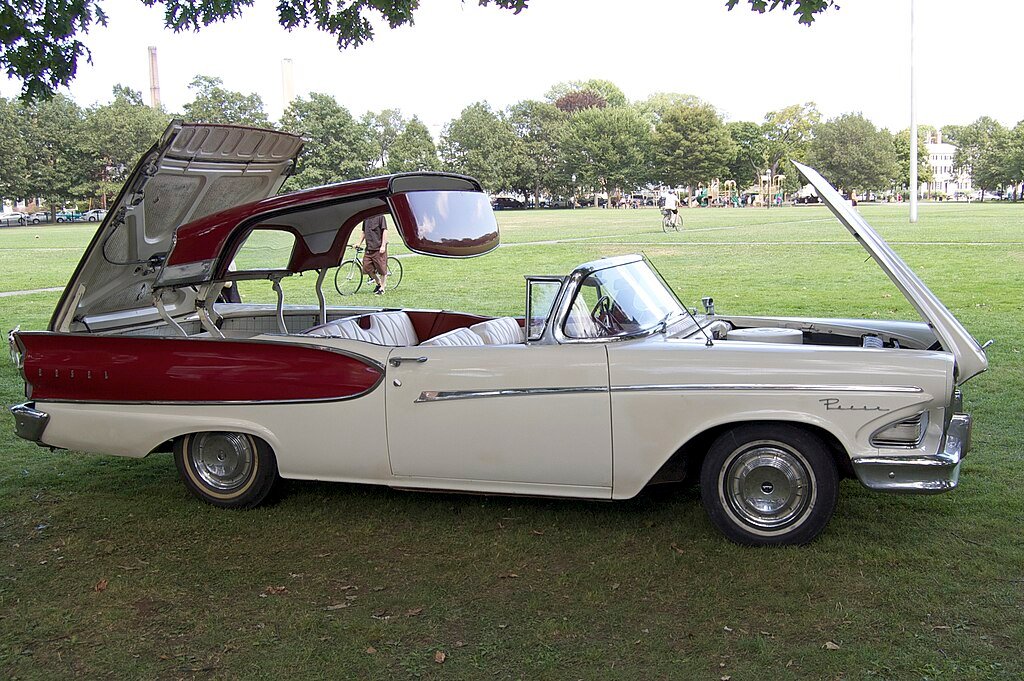
In the mid-1950s, Ford Motor Company was riding high on post-war prosperity but faced a strategic challenge. The company’s leadership identified a gap in their product lineup between the mainstream Ford brand and the luxury Lincoln division. To bridge this gap, Ford initiated what would become one of the most expensive and extensive product development programs in automotive history at that time.
The new division was named after Edsel Ford, the only son of company founder Henry Ford and a former company president who had died in 1943. The choice of name would later prove controversial, but at the time, it represented the company’s commitment to innovation and family heritage.
Development and Expectations
Ford spared no expense in developing the Edsel. The company invested approximately $250 million (equivalent to over $2.3 billion in 2024 dollars) in the project. The development team conducted extensive market research, though ironically, their findings would later be criticized for confirming existing assumptions rather than challenging them.
The marketing campaign was equally ambitious. Ford created an unprecedented level of anticipation through a teaser campaign that kept the car’s actual appearance secret until its reveal. The company promised that the Edsel would be something entirely new in the automotive world, setting expectations extraordinarily high.
The Revolutionary Design
When finally unveiled, the Edsel’s most distinctive feature was its vertical grille, dubbed by critics as the “horse collar” or less flatteringly, the “toilet seat.” While intended to be revolutionary, this design choice became one of the car’s most controversial aspects. The Edsel also featured innovative technologies for its time, including self-adjusting brakes, automatic lubrication systems, and ergonomic controls like its distinctive “Teletouch” push-button transmission selector in the center of the steering wheel.
Market Reality and Timing
The Edsel’s launch in September 1957 coincided with the beginning of a recession, immediately hampering its chances of success. The market was shifting toward smaller, more economical cars, while the Edsel represented the peak of 1950s automotive excess. Additionally, quality control issues plagued early production models, damaging the brand’s reputation from the start.
The Complex Reasons for Failure
The Edsel’s failure cannot be attributed to a single factor but rather a perfect storm of challenges:
- Economic Timing: The 1957-58 recession severely impacted the market for medium-priced cars just as the Edsel launched.
- Market Positioning: The car occupied an increasingly crowded market segment that was actually shrinking as consumer preferences shifted.
- Quality Issues: Early production problems led to reliability concerns and negative word-of-mouth.
- Price Point Confusion: Different Edsel models overlapped in price with existing Ford and Mercury lines, creating internal competition.
- Overhyped Expectations: The massive marketing campaign created unrealistic expectations that the actual product couldn’t meet.
Legacy and Lessons
The Edsel’s production ended in November 1959, after just over two years and approximately 118,000 units built. Ford’s total losses on the project were estimated at $250-350 million. However, the Edsel’s importance extends far beyond its brief life as a production vehicle.
The Edsel case study has become required reading in business schools worldwide, offering valuable lessons about market research, product development, and the dangers of corporate hubris. It demonstrates how even extensive market research can fail if it asks the wrong questions or confirms existing biases rather than challenging assumptions.
The Edsel Today
Ironically, the Edsel’s notorious failure has made surviving examples highly collectible. What was once considered an embarrassment has become a valued piece of automotive history, with well-preserved models commanding significant prices at auctions. The car’s distinctive design, once widely criticized, is now appreciated as a unique expression of 1950s automotive styling.
The Edsel Lesson on Market Research and Customer Expectations
The Edsel story remains relevant today as companies continue to launch new products into evolving markets. Its lessons about timing, market research, and managing expectations resonate across industries. While the Edsel represents a significant financial failure for Ford, its legacy as a learning opportunity in business and product development strategy has proven invaluable. The story serves as a reminder that success in the marketplace requires not just ambitious vision and substantial resources, but also precise timing and a clear understanding of consumer needs and desires.
The Edsel stands as more than just a failed car model; it represents a crucial moment in corporate history that continues to inform business strategy and product development practices today. Its story reminds us that even the most well-resourced and carefully planned ventures can fail when they lose touch with market realities and consumer preferences.
To continue your journey through automotive history and discover more fascinating stories like the Edsel saga, follow Classic Cars Online US on NewsBreak. Their daily updates provide fresh perspectives on vintage vehicles, newly uncovered historical details, and expert analysis that brings these classic cars to life. Stay connected with a community that shares your passion for automotive heritage and the enduring lessons these vehicles teach us about innovation, design, and market dynamics.