
Originally published April 7. 2016|Updated October 8, 2026
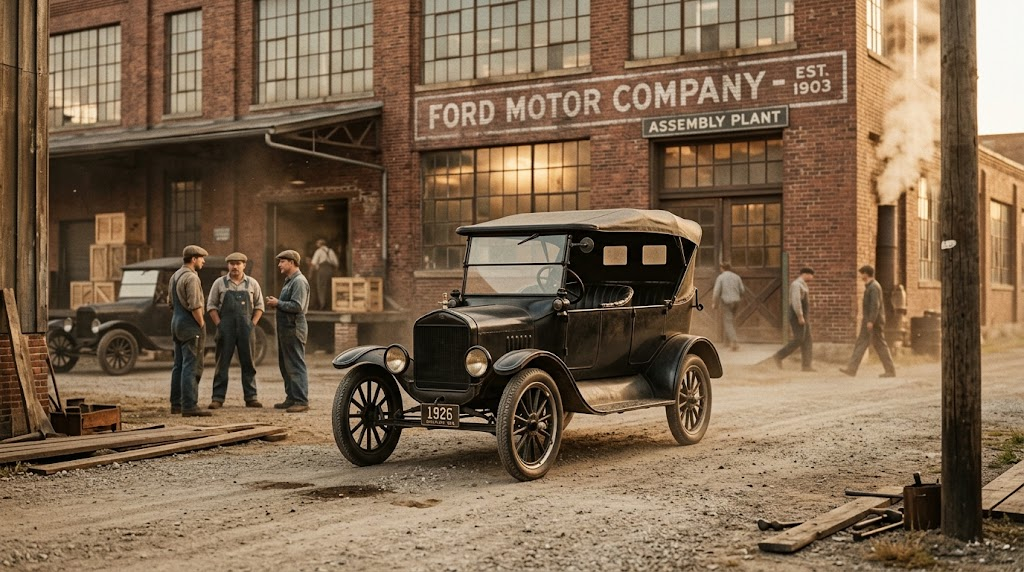
Few companies have shaped daily life the way Ford Motor Company has. Founded in 1903 and headquartered in Dearborn, Michigan, Ford put ordinary families behind the wheel, helped pioneer modern manufacturing, and built some of the most recognizable vehicles ever made. Along the way, it survived financial crises, family feuds, two world wars, and a near-collapse in the 2000s. This guide walks through the major chapters of the story.
How Ford Motor Company Began
Henry Ford had already built racing cars and launched an earlier company that failed before he tried again. Ford Motor Company was incorporated on June 16, 1903, backed by a small group of investors. Coal dealer Alexander Malcomson helped assemble the money, and banker John S. Gray became the first president, with Henry Ford as vice president and chief engineer. The group included twelve investors in all, among them brothers John and Horace Dodge, who supplied parts in the early days.
The Early Alphabet Cars
Ford’s first product, the 1903 Model A, was a simple two-cylinder car with about 8 horsepower, and roughly 1,750 were sold in the first fifteen months. A string of models followed, each with its own letter:
- Model C (1904-1905): a refined Model A with a more powerful engine
- Model N (1906): an affordable four-cylinder car that proved the market for low-priced Fords
- Model K (1906-1908): an expensive six-cylinder flagship that sold poorly
- Model S (1907): a roadster that never found a big audience
The lesson Ford took from the Model K was clear. The money was in a car ordinary people could afford.
The Model T Changes Everything
The Model T arrived in 1908 and became the most influential car of its era. It was tough, simple to repair, and priced for the middle class. Ford then reinvented how cars were built. In 1913, the moving assembly line at the Highland Park plant cut the time needed to build a car dramatically, and in 1914 the company introduced its famous $5 workday, which reduced turnover and helped workers afford the cars they built.
As efficiency improved, prices fell from $850 at launch to under $300 by the mid-1920s. The fifteen millionth Model T rolled off the line on May 26, 1927, and production ended later that year. For classic car fans, the Model T remains one of the most collected and restored cars in the world.
Ford During World War I
Henry Ford was an outspoken pacifist during WWI. In 1915 he sponsored a “peace ship” voyage to Europe in a failed attempt to end the fighting. Once the United States entered the war in 1917, though, Ford’s factories shifted to the war effort, building Model T-based ambulances and other military equipment. The war cemented Ford’s reputation for mass production at scale.
Expansion and Setbacks in the 1920s and 1930s
After the war, Ford tightened its control of the company, buying out minority shareholders in 1919 after a legal fight with the Dodge brothers. Henry’s son Edsel became president that same year.
By the mid-1920s, competitors like General Motors were winning customers with annual styling updates, more color choices, and installment financing. Ford responded by replacing the Model T with an all-new Model A in 1927 and, in 1932, introducing the affordable flathead V8 engine. Key moves during this period included:
- Lincoln acquisition (1922): Ford entered the luxury market
- Fordlandia (1928): a costly rubber plantation venture in Brazil that failed
- Mercury (1938): a new division aimed at the mid-priced market
Ford During The Great Depression
The Depression hit Ford hard, with production cuts and mass layoffs. On March 7, 1932, thousands of unemployed workers marched on the River Rouge plant in what became known as the Ford Hunger March. Police and company security opened fire, and five marchers were killed. The event remains one of the darkest episodes in the company’s labor history, and Ford did not recognize a union until 1941.
Ford During World War II
When the United States entered World War II, Ford became a major military manufacturer. The company’s Willow Run plant in Michigan built B-24 Liberator bombers at a pace of roughly one per hour at its peak, and Ford also produced Jeeps, aircraft engines, and other equipment.
The company’s German story is more complicated. Before the war, Ford’s German subsidiary, Ford-Werke, built trucks for the German military, and Henry Ford received a medal from the Nazi government in 1938. After the U.S. entered the war in late 1941, direct ties ended and the German operation came under Nazi control. Historians have documented that the subsidiary used forced labor during the war, and Ford has acknowledged this part of its past.
Postwar Ford Leadership and Iconic Cars
Edsel Ford died in 1943, and by 1945 an aging Henry Ford was persuaded to step aside for his grandson, Henry Ford II. The company was losing millions of dollars a month, and the young president brought in a team of outside managers to modernize operations. Henry Ford died in 1947. In 1956, Ford went public, though the family kept significant voting control.
The postwar decades produced some of Ford’s best-loved vehicles, including:
- Thunderbird (1955): a stylish two-seater that created the “personal luxury” segment
- Falcon (1960): a compact, economical family car
- Mustang (1964): the original pony car and an instant sensation
- GT40 (late 1960s): the race car that won four straight 24 Hours of Le Mans titles, starting in 1966
Ford also had misses, most famously the Edsel brand of the late 1950s, which became a textbook marketing failure. In 1967, Ford formally established Ford of Europe, strengthening its global footprint.
Ford From the 1980s to the 2000s
Ford’s F-Series pickups became the best-selling vehicles in the United States, a position they have held for decades, and cars like the Taurus and the Explorer defined entire categories. In the late 1980s and 1990s, Ford expanded globally by acquiring brands such as Jaguar, Volvo, and Land Rover, most of which it later sold.
Leadership continued to turn over. William Clay Ford Jr., Henry Ford’s great-grandson, became CEO in 2001, and Alan Mulally arrived from Boeing in 2006. That year, Ford borrowed heavily against its assets, including its famous blue oval logo, to fund a major restructuring. When the 2008-2009 financial crisis pushed General Motors and Chrysler into government-backed bankruptcies, Ford avoided that outcome, although it did receive a federal loan to help retool its plants for fuel-efficient vehicles.
Ford Today
Since 2020, CEO Jim Farley has steered the company through the shift to electrification, with vehicles like the Mustang Mach-E and the F-150 Lightning bringing the Ford badge into the electric era. At the same time, trucks, vans, and the enduring Mustang continue to carry the brand’s heritage. Over more than a century, Ford has repeatedly reinvented itself, and that capacity for reinvention is a big part of why it is still here.
Free Ford History Coloring Page to Download
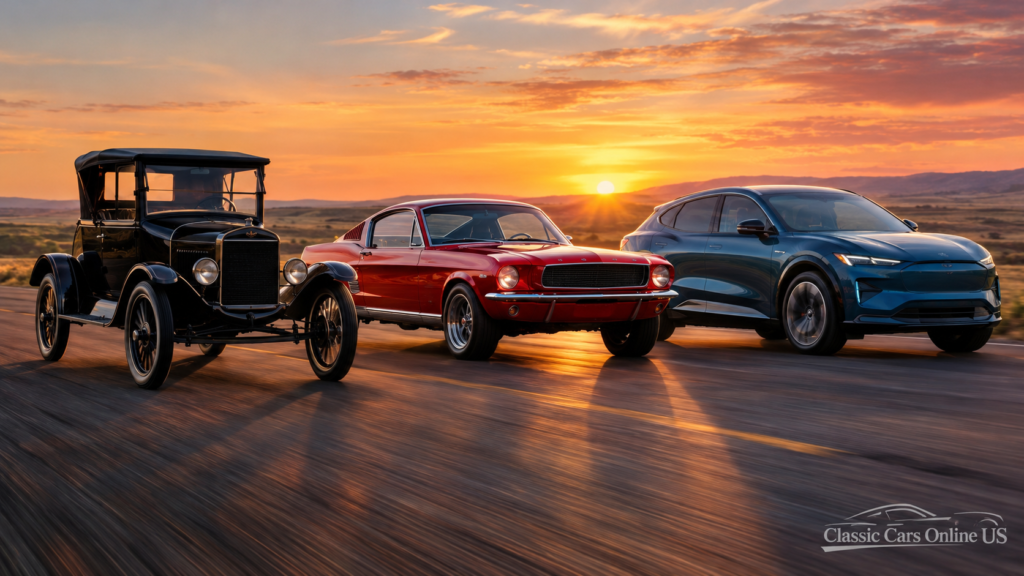
Want to take the Ford story beyond the screen? We’ve created a free printable coloring page that puts three generations of Ford side by side: a 1920s Model T, a 1960s Mustang fastback, and a modern Mustang Mach-E, all cruising toward the same sunset. It’s a fun way to slow down and appreciate how far Ford has come, and it works equally well for classic car fans, kids, and grandkids who like to color alongside you. Colored pencils and crayons work best. Download the free Ford history coloring page (PDF) below and print as many copies as you like for personal use.
Key Takeaways
Ford’s history is a story of bold bets, hard lessons, and constant adaptation. Its founding in 1903 set the stage, the Model T and the assembly line changed manufacturing for good, and the company’s wartime role, postwar icons, and modern electric push show how much it has evolved. For additional reading, you can visit Ford’s official company history and the Encyclopaedia Britannica entry on Ford Motor Company, or browse around here, on the Classic Cars Online US website.