
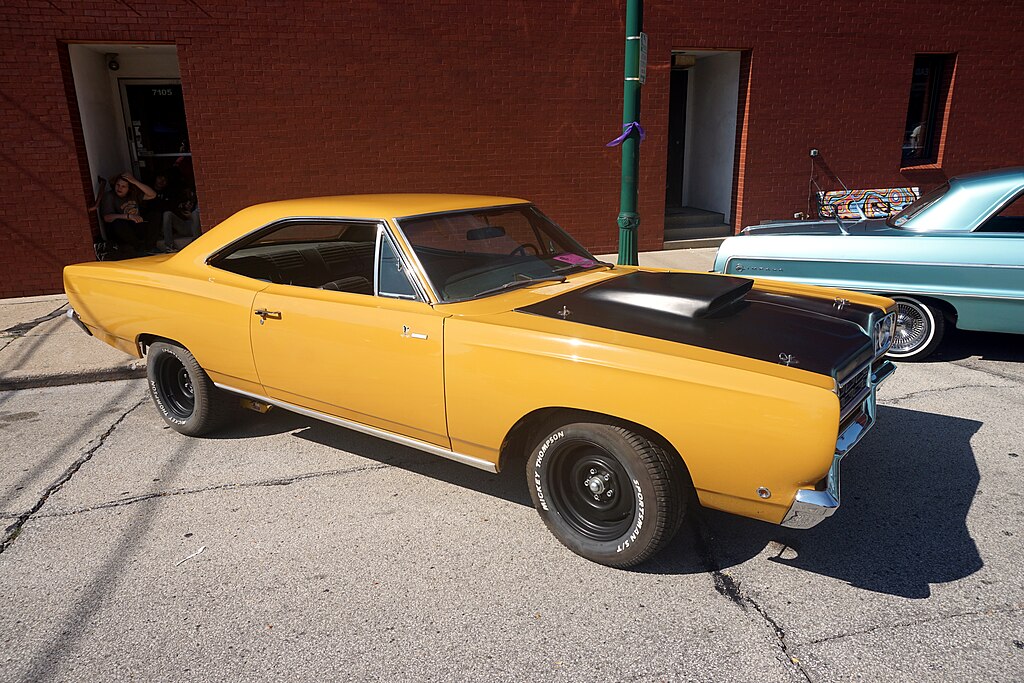
When Plymouth introduced the Road Runner in 1968, it redefined the muscle car segment with a simple yet revolutionary concept: maximum performance at a minimal price. Built on the Belvedere platform, the Road Runner stripped away luxury pretenses to deliver raw power to young buyers who cared more about quarter-mile times than leather seats.
First-Gen Plymouth Road Runner: Origins and Development
Plymouth’s market research in the mid-1960s revealed an untapped market for a budget-friendly muscle car. While the GTX offered luxury with performance, many young buyers couldn’t afford its premium price tag. Plymouth’s solution was brilliantly straightforward – create a bare-bones muscle car with serious performance credentials at a price point under $3,000.

The Warner Brothers Connection In a stroke of marketing genius, Plymouth paid Warner Brothers $50,000 for the rights to use the Road Runner name and likeness. This included the distinctive “beep-beep” horn sound that became a signature feature. The cartoon-inspired marketing perfectly aligned with the car’s youthful target audience and rebellious spirit.
First-Gen Plymouth Road Runner: Performance and Engineering
The standard powerplant was the rugged 383 cubic inch V8, rated at 335 horsepower. This engine featured heads, intake manifold, camshaft, and exhaust manifolds from the mighty 440 Super Commando. For those seeking ultimate performance, Plymouth offered the legendary 426 Hemi as an option, delivering 425 horsepower and quarter-mile times in the low 13-second range.
First-Gen Plymouth Road Runner: Technical Specifications:
- Base Engine: 383 cu in (6.3L) V8
- Horsepower: 335 hp @ 5,200 rpm
- Torque: 425 lb-ft @ 3,400 rpm
- Optional 426 Hemi V8
- Horsepower: 425 hp @ 5,000 rpm
- Torque: 490 lb-ft @ 4,000 rpm
- Transmission Options:
- 4-speed manual
- TorqueFlite 3-speed automatic
- Wheelbase: 116 inches
- Curb Weight: Approximately 3,450 lbs
First-Gen Plymouth Road Runner: Body Styles and Features
Available as either a pillared coupe or hardtop (with convertible added in 1969), the Road Runner’s exterior was deliberately stark. The hood featured functional air scoops, and minimal badging identified the model. Inside, the basic interior featured a bench seat and rubber floor mats, though buyers could opt for upgrades like bucket seats and carpeting.
First-Gen Plymouth Road Runner: Factory Options and Packages:
Performance Options:
- Air Grabber hood (1969-1970): Hidden headlight-style air intakes that opened under acceleration
- 440 Six Pack (mid-1969-1970): Three two-barrel carburetors producing 390 hp
- Heavy-duty suspension package
- Power front disc brakes
- Sure-Grip differential with various gear ratios (3.23, 3.54, 3.91, 4.10)
- Performance axle packages
- Dual exhaust system with chrome tips
Exterior Options:
- Vinyl roof covering
- Hood paint stripes
- Body side stripes
- Chrome dual racing mirrors
- Deluxe wheel covers
- Rally wheels
- Chrome exhaust tips
- Electric sunroof (rare)
- Sport hood treatment
- Bumper guards
- Painted bumpers
Interior Options:
- Bucket seats with optional center console
- TorqueFlite automatic transmission
- Tachometer
- Rally instrument cluster with wood grain panel
- AM/FM radio
- Power steering
- Air conditioning (not available with 426 Hemi)
- Deluxe interior package
- Wood grain steering wheel
- Light package
- Rear window defogger
Special Editions and Packages: 1969:
- “M” Code Package: Included heavy-duty suspension, Hemi springs, heavy-duty brake linings
- A12 440 Six Pack Package: Included lift-off fiberglass hood, heavy-duty suspension, 4.30 Dana rear 1970:
- Road Runner Plus Package: Added premium interior and exterior trim
- Air Grabber Package: Included remote-operated hood scoop
- Performance Hood Package: Featured twin NASA-style hood scoops
First-Gen Plymouth Road Runner: Racing Heritage
The Road Runner quickly proved its worth on both street and strip. The lightweight design combined with powerful engine options made it a favorite among drag racers. Professional teams modified Road Runners for NASCAR competition, where they competed successfully against other muscle cars of the era.
Evolution Through the First Generation
- 1968: Initial release with basic trim and powerful engines
- 1969: Added convertible option, refined styling with new grille and taillights
- 1970: Major redesign with new sheet metal, hood treatment, and interior updates
First-Gen Plymouth Road Runner: Cultural Impact
The Road Runner represented a perfect storm of marketing, performance, and timing. It arrived when young buyers were eager for affordable performance cars, and its cartoon mascot added a touch of irreverent humor that resonated with the counterculture of the late 1960s. The model’s success influenced other manufacturers to create their own budget muscle cars, though few captured the Road Runner’s perfect balance of price and performance.
Sales figures tell the story of its success:
- 1968: 44,599 units
- 1969: 84,420 units (peak year)
- 1970: 43,404 units
Detailed Production Breakdown:
1968:
- Total Production: 44,599
- 2-Door Hardtop: 29,240
- 2-Door Post Coupe: 15,359
- 426 Hemi: 1,019 total (789 Hardtop, 230 Post Coupe)
- 383 V8: 43,580
- Manual Transmission: 19,295
- Automatic Transmission: 25,304
1969:
- Total Production: 84,420
- 2-Door Hardtop: 48,549
- 2-Door Post Coupe: 33,743
- Convertible: 2,128
- 426 Hemi: 788 total
- 440 Six Pack (introduced mid-year): 1,432
- 383 V8: 82,200
- Manual Transmission: 32,105
- Automatic Transmission: 52,315
1970:
- Total Production: 43,404
- 2-Door Hardtop: 24,304
- 2-Door Post Coupe: 18,880
- Convertible: 220
- 426 Hemi: 652
- 440 Six Pack: 1,920
- 383 V8: 40,832
- Manual Transmission: 14,256
- Automatic Transmission: 29,148
The first-generation Road Runner remains one of the most significant muscle cars ever produced. It proved that high performance didn’t require luxury trimmings or a premium price tag. Today, it stands as a testament to an era when American manufacturers built cars that delivered exactly what young performance enthusiasts wanted – pure, unadulterated horsepower in a package they could afford.
Ready to dive deeper into the world of classic cars?
Explore our extensive collection of articles, buyer’s guides, and classic car listings right here on Classic Cars Online US. And don’t forget to join our thriving community of enthusiasts on Facebook! Connect with fellow collectors, share your stories, and discover amazing classics in our Facebook group “Classic Cars Online US: Classic Cars for Sale“. Whether you’re a seasoned collector or just starting your classic car journey, you’ll find a warm welcome and a wealth of knowledge in our online community.