
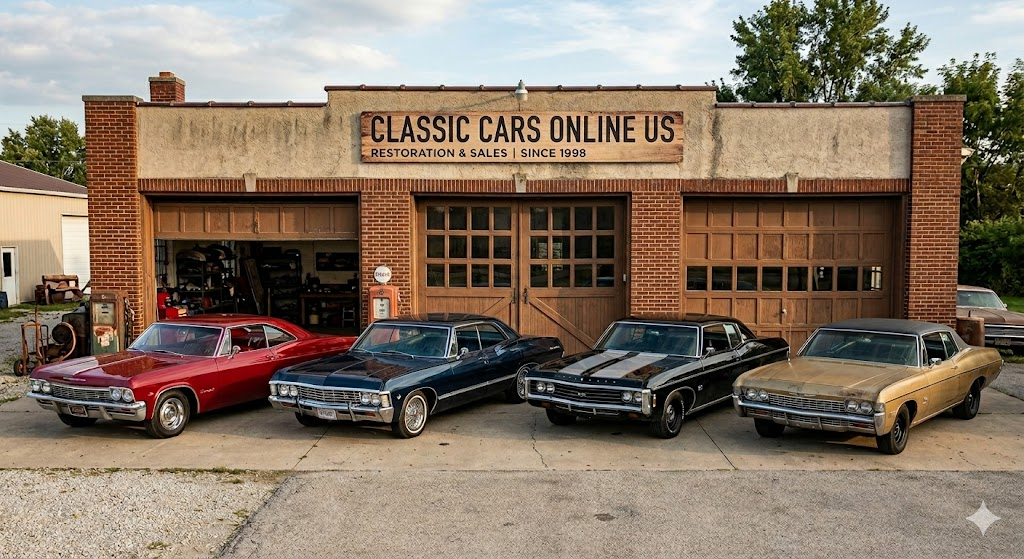
The fourth generation Chevy Impala specs cover Impala models manufactured from 1965 through 1970, spanning six model years and one of the most celebrated eras in American full-size automobile history.
Built on the GM B-body platform with a 119-inch wheelbase throughout the generation, these Impalas offered buyers a wide range of body styles, engine options, and trim levels — from practical family sedans to the high-performance Impala SS with big-block V8 power.
This hub page collects factory specifications for all six model years (scroll down for links to each model year’s specs.)
Each year is summarized below, with links to full individual spec sheets covering engine data, transmission details, chassis measurements, electrical specs, and factory options.
Note on generation dates: Some sources list this generation as starting in 1964. However, the 1964 Impala used the previous X-frame chassis. The 1965 model marked the true generational break, introducing the new perimeter frame and full-coil suspension that defined this era.
What Makes the 4th Gen Impala a Different Breed?
Chevrolet’s 1965 redesign was a watershed moment for the Impala. The old X-frame chassis was retired in favor of a full-width perimeter frame with a redesigned full-coil suspension, delivering a quieter, more composed ride without sacrificing performance. The bodies became more curvaceous, with sharper windshield angles and frameless side glass on pillarless coupe body styles.
The 1965 Impala set an all-time industry annual sales record of more than one million units in the United States, and that’s a record that’s never been broken. The platform it rode on, the GM B-body, went on to become the fourth best-selling automobile platform in history.
Two major restylings occurred within the generation: the original 1965 design carried forward (with facelifts) through 1966, a redesigned Coke-bottle body arrived for 1967 and continued through 1968, and new slab-sided styling debuted for 1969 and carried into 1970.
4th Gen Impala Specs at a Glance (1965-1970)
The table below summarizes key specifications across all six model years. Click any year for the full spec sheet (pending).
| Year | Engine Range | Peak HP | Wheelbase | Body Styles | Production |
| 1965 | Inline-6 to 409/396 V8 | 425 hp (409) | 119 in. | Sedan, Hardtop, Convertible, Wagon | 803,400 |
| 1966 | Inline-6 to 427 V8 | 425 hp (427) | 119 in. | Sedan, Hardtop, Convertible, Wagon | 654,900 |
| 1967 | Inline-6 to 427 V8 | 385 hp (427) | 119 in. | Sedan, Hardtop, Convertible, Wagon | 575,600 |
| 1968 | Inline-6 to 427 V8 | 425 hp (427) | 119 in. | Sedan, Hardtop, Custom Coupe, Convertible, Wagon | ~600,000 |
| 1969 | Inline-6 to 427 V8 | 425 hp (427) | 119 in. | Sedan, Hardtop, Sport Coupe, Convertible, Wagon | 777,000 |
| 1970 | Inline-6 to 454 V8 | 390 hp (454) | 119 in. | Sedan, Hardtop, Custom Coupe, Convertible, Wagon | ~600,000 |
What Engines Did the 4th Gen Impala Come With?
Engine availability evolved significantly across the generation, but the base powerplant was a 250 cubic-inch Turbo-Thrift inline-six producing 155 horsepower, available throughout the run.
Small-block V8s included 283, 307, and 327 cubic-inch options depending on the year.
The big performance story was the introduction of the Mark IV big-block family; starting with the 396 in 1965 and expanding to the legendary 427 by 1966.
For 1970, the 427 was replaced by the new 454 cubic-inch Turbo-Jet V8, rated at 390 horsepower. This was also the last year for the Impala SS in this generation, as Chevrolet discontinued the Super Sport package after 1969.
| Engine | Displacement | Carb | HP (Gross) | Torque | Years Available |
| Turbo-Thrift Inline-6 | 250 cu in. | 1-bbl Rochester | 155 hp @ 4,200 rpm | 235 lb-ft @ 1,600 rpm | 1965-1970 |
| Turbo-Fire V8 | 283 cu in. | 2-bbl | 195 hp @ 4,800 rpm | 285 lb-ft @ 2,400 rpm | 1965-1967 |
| Turbo-Fire V8 | 283 cu in. | 4-bbl | 220 hp @ 4,800 rpm | 295 lb-ft @ 3,200 rpm | 1965-1967 |
| Turbo-Fire V8 | 327 cu in. | 2-bbl | 250 hp | 350 lb-ft | 1965-1967 |
| Turbo-Fire V8 | 327 cu in. | 4-bbl | 275 hp @ 4,800 rpm | 355 lb-ft @ 3,200 rpm | 1965-1967 |
| Turbo-Jet V8 | 396 cu in. | 4-bbl | 325-425 hp | 410 lb-ft | 1965-1969 |
| Turbo-Jet V8 (W-series 409) | 409 cu in. | 4-bbl | 340-400 hp | — | 1965 only |
| Turbo-Jet V8 | 427 cu in. | 4-bbl | 385-425 hp | — | 1966-1969 |
| Turbo-Fire V8 | 307 cu in. | 2-bbl | 200 hp @ 4,600 rpm | 300 lb-ft @ 2,400 rpm | 1969-1970 |
| Turbo-Jet V8 | 454 cu in. | 4-bbl | 390 hp | — | 1970 only |
All horsepower figures are SAE gross ratings, the standard used by manufacturers in this era. SAE net figures (adopted after 1971) would be approximately 20-30% lower.
What Transmissions Were Available?
Three transmission families were offered across this generation, with availability depending on the engine selected:
| Transmission | Type | Notes |
| Synchro-Mesh 3-speed | Manual, column shift | Standard with inline-6 and small-block V8s |
| Close-ratio 4-speed | Manual, floor shift | Optional with performance V8s; Muncie unit |
| Powerglide 2-speed | Automatic | Available with inline-6, 283, and 327 V8s |
| Turbo Hydra-Matic 3-speed | Automatic | Required with 396 and 427 V8s; available on others |
4th Gen Impala Dimensions and Chassis Specs
The 119-inch wheelbase remained constant throughout the generation. Overall length varied slightly year to year due to styling changes at the front and rear.
| Spec | 1965-1966 | 1967-1968 | 1969-1970 |
| Wheelbase | 119 in. | 119 in. | 119 in. |
| Overall Length (Sport Coupe) | 213.1 in. | 213.2 in. | ~216 in. |
| Overall Width | 79.5-79.6 in. | ~79.9 in. | ~79.9 in. |
| Front Tread | 62.5 in. | 62.5 in. | 62.5 in. |
| Rear Tread | 62.4 in. | 62.4 in. | 62.4 in. |
| Curb Weight (Sport Coupe) | ~3,700 lbs. | ~3,800 lbs. | ~3,900 lbs. |
| Standard Tires | 7.35 x 14 | 8.25 x 14 | 8.25 x 14 |
Body Styles Available Each Year
The 4th gen Impala was offered in a broader range of configurations than most enthusiasts realize. Station wagons were rebadged as Kingswood beginning in 1969.
| Body Style | Years Available | Notes |
| 4-Door Sedan | 1965-1970 | Pillar sedan; standard trim |
| 4-Door Hardtop Sport Sedan | 1965-1970 | Pillarless hardtop |
| 2-Door Hardtop Sport Coupe | 1965-1970 | Most popular body style |
| 2-Door Convertible | 1965-1969 | Dropped after 1969 |
| 4-Door Station Wagon (2-seat) | 1965-1968 | Rebadged Kingswood in 1969 |
| 4-Door Station Wagon (3-seat) | 1965-1968 | Rebadged Kingswood in 1969 |
| Custom Coupe (formal roofline) | 1968-1970 | New for 1968; formal hardtop |
Year-by-Year Spec Sheet Summaries
1965 Chevy Impala Specs
The 1965 Impala was a ground-up redesign. The new perimeter frame replaced the previous X-frame, and a full-coil suspension improved ride quality. Visually, the 1965 is identified by its three round taillights. The 396 cubic-inch big-block was introduced mid-year, replacing the 409. Total Impala production reached 803,400 units, setting an all-time industry sales record.
[Link pending: Full 1965 Chevy Impala Spec Sheet]
1966 Chevy Impala Specs
The 1966 received a mild facelift with a revised grille, rectangular taillights, and new instrument panel. The 427 cubic-inch big-block joined the engine lineup. Standard features now included lap belts front and rear, reverse lamps, and a padded dashboard. Production totaled 654,900 units.
[Link pending: Full 1966 Chevy Impala Spec Sheet]
1967 Chevy Impala Specs
The 1967 model year brought the most significant visual overhaul of the generation, including a new Coke-bottle body with Corvette-inspired fender bulges, a wider front grille, and trapezoidal taillights.
Federal safety mandates added a collapsible steering column and shoulder belts. The SS427 package (Z24) debuted, limited to approximately 2,124 units. Production was 575,600 units.
[Link pending: Full 1967 Chevy Impala Spec Sheet]
1968 Chevy Impala Specs
The 1968 carried the Coke-bottle body forward with refinements including concealed windshield wipers and triple horseshoe-shaped taillights housed in the new rear bumper. A new body style, the Custom Coupe with formal roofline, was introduced and continued through the end of the generation. The L72 427 returned at 425 horsepower.
[Link pending: Full 1968 Chevy Impala Spec Sheet]
1969 Chevy Impala Specs
A new slab-sided body arrived for 1969, with horizontal taillights and a more formal appearance. Disc brakes were standard on the SS427 that year — the only year this was true. This was also the last year for the Impala SS and the last year for convertible production. Total production reached 777,000 units, the highest of any year in this generation after 1965.
[Link pending: Full 1969 Chevy Impala Spec Sheet]
1970 Chevy Impala Specs
The 1970 Impala carried the 1969 body with a revised front end, replacing the wraparound bumper with a more conventional under-grille unit. The Impala SS was discontinued, but buyers could still order the new 454 Turbo-Jet V8 producing 390 horsepower. The 454 would become a signature option across Chevrolet’s lineup heading into the early 1970s.
[Link pending: Full 1970 Chevy Impala Spec Sheet]
Impala SS: Super Sport Specifications Summary
The Super Sport package was a factory performance and appearance option available throughout most of this generation. It was offered as a standalone model (with its own VIN prefix) from 1965 through 1967, then as an option package (RPO Z03/Z24) from 1968 onward.
| Year | SS Designation | Top Engine Option | Approx. Units Built | Notes |
| 1965 | Separate model | 409 or 396 V8 | 243,114 | First SS on new platform |
| 1966 | Separate model | 427 V8 (425 hp) | — | SS 396 and SS 427 sub-models |
| 1967 | Separate model (Z24) | 427 V8 (385 hp) | ~2,124 | Domed hood; rarest SS year |
| 1968 | Option (Z24) | 427 V8 (425 hp) | ~1,778 | SS427 badges interior only |
| 1969 | Option (Z24) | 427 V8 (425 hp) | ~2,455 | Disc brakes standard; last SS year |
| 1970 | Discontinued | 454 V8 (390 hp) | N/A | No SS; 454 still orderable |
How to Decode a 4th Gen Impala VIN
For 1965-1969 models, the VIN is located on a steel plate attached to the left door jamb (1965-1967) or riveted to the upper dash panel (1968-1969). The second through fifth digits identify the series, engine, and body style as follows:
| VIN Digit(s) | What It Indicates | Example |
| 2nd digit | Series (Biscayne, Impala, etc.) | 6 = Impala |
| 3rd digit | Engine (6 or 8 cylinder) | 3 = 6-cyl; 4 = 8-cyl |
| 4th & 5th digits | Body style | 37 = 2-Dr Hardtop; 67 = 2-Dr Convertible; 69 = 4-Dr Sedan; 39 = 4-Dr Hardtop |
For a full VIN decode including assembly plant codes and production sequence numbers, refer to the individual year spec sheets.
Building Your 4th Gen Impala Spec Reference
Whether you are restoring a 1965 Sport Coupe, verifying the originality of a 1967 SS427, or simply researching values before buying, factory specifications are the foundation of any serious Impala project. The individual year spec sheets on Classic Cars Online US cover each model year in detail, including engine-specific tuning specs, factory color codes, and option availability.
Use the links above to navigate to any year, or browse the full Classic Car Spec Sheets library for factory documentation on other makes and models.
Spec data compiled from factory documentation, Chevrolet production records, and established marque resources. All horsepower figures are SAE gross as originally published. Contact us if you spot an error or want to suggest a correction.