
Originally published April 9, 2016|Updated October 25, 2026
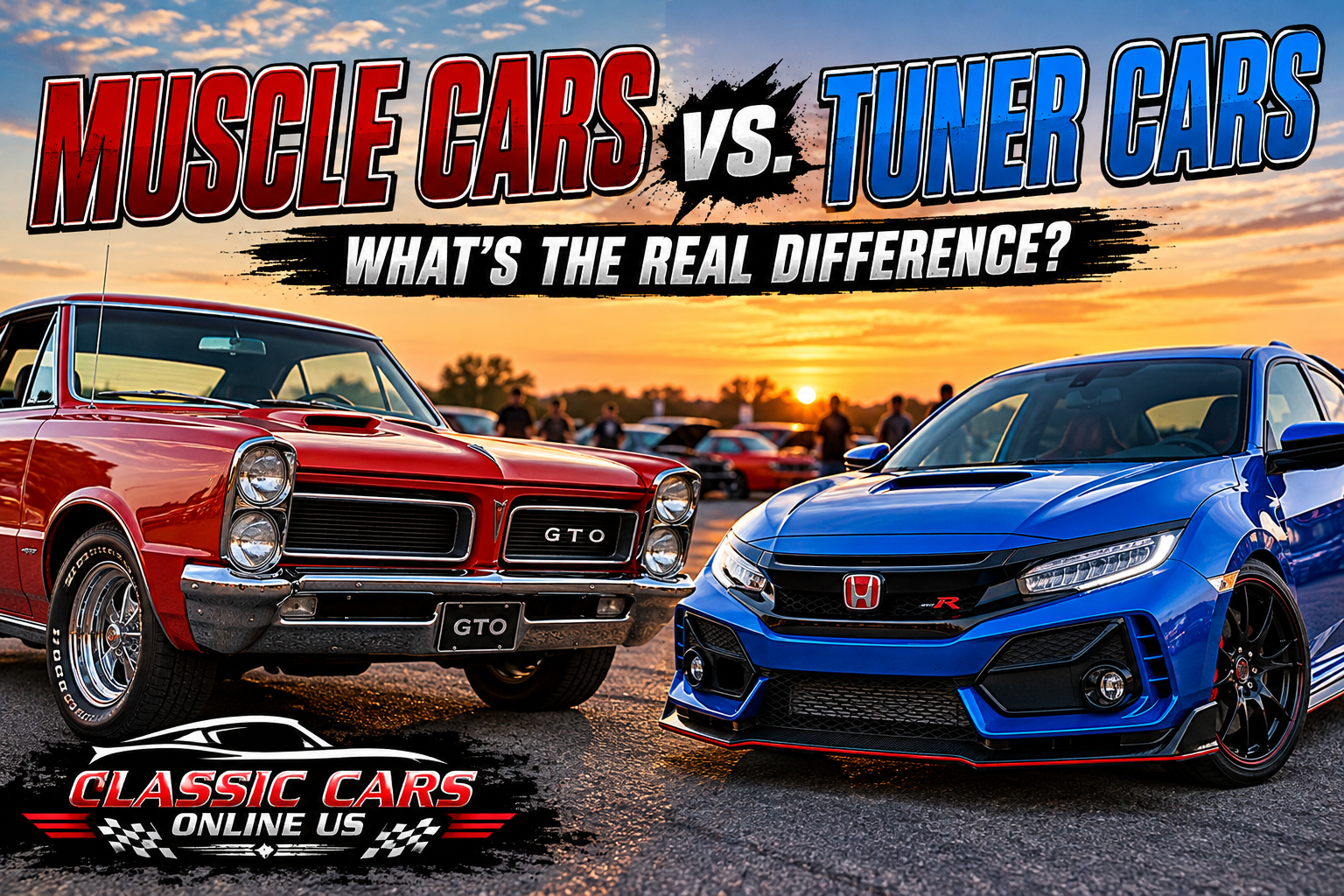
Put a Pontiac GTO next to a modified Honda Civic at a car meet, and you could start an argument in about ten seconds. Which one is faster? Which one is cooler? Which one is a “real” performance car?
The muscle cars vs. tuner cars debate has been running for decades. The truth is that both are about the same thing: taking a regular car and making it go faster. They just get there by very different roads.
Let’s break it down in plain English.
What Is a Muscle Car?
The Britannica Dictionary describes a muscle car as an American-made two-door sports car with a powerful engine. That’s a good starting point, though fans still argue over the fine print.
The idea is simple. Take a mid-size car and drop in the biggest, strongest engine the factory offers. The Pontiac GTO of the mid-1960s is often credited as the car that kicked off the craze. Merriam-Webster notes that the term “muscle car” first showed up in 1966.
Classic muscle cars usually share a few traits:
- A big V8 engine
- Rear-wheel drive
- A heavy, solid body
- Simple, no-frills mechanics
- Straight-line speed as the main goal
Think Chevelle SS, Dodge Charger, Plymouth Road Runner and Ford Torino. If you want to see more of them, check out our guides to GM muscle cars, Ford muscle cars and Chrysler muscle cars.
What Is a Tuner Car?
A tuner car starts out as an everyday, practical vehicle. Often it’s a small, lightweight import like a Honda Civic, Nissan 240SX, Toyota Supra or Subaru WRX. Owners then “tune” it, which just means upgrading parts to get more performance.
Typical tuner upgrades include:
- A turbocharger, which uses exhaust gas to force extra air into the engine for more power
- Sport suspension for sharper handling
- Lighter wheels and better tires
- Improved brakes
- Engine computer tweaks
Tuners usually start with good fuel economy, easy handling and a lower price. Then the owner builds on that foundation. The tuner scene grew hugely in the 1990s and early 2000s, and it’s still going strong.
Muscle Cars vs. Tuner Cars: Head-to-Head
Power and Torque
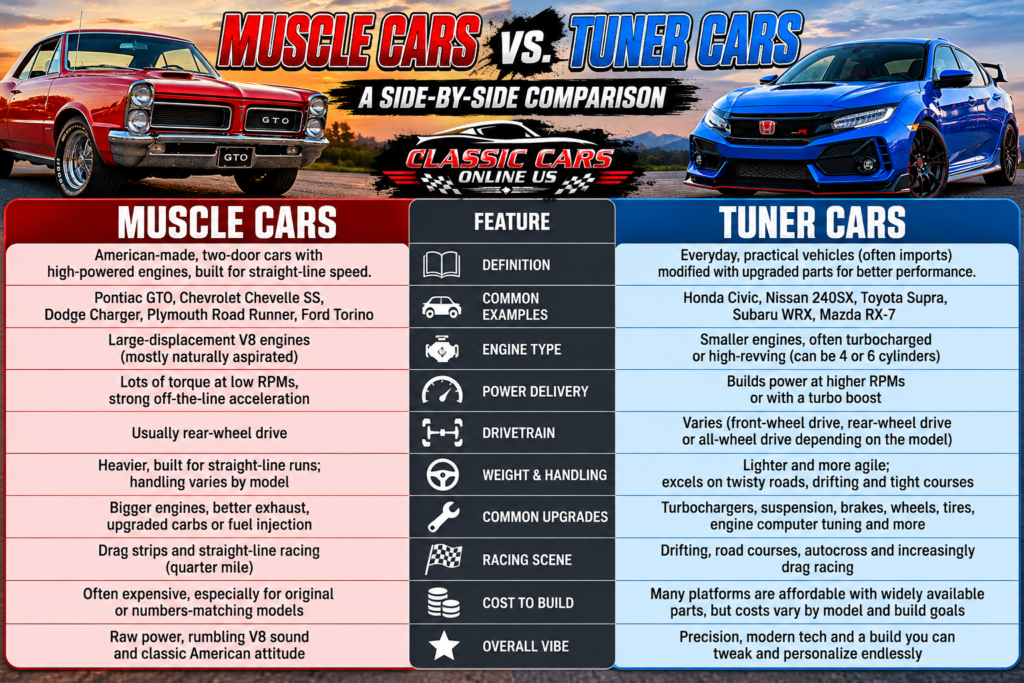
Torque is the twisting force that shoves you back in your seat when you hit the gas. A big V8 makes lots of it right away, even at low engine speeds. That’s why muscle cars feel so strong off the line.
Tuner engines are smaller. They often need higher RPMs, or a turbo kicking in, to make their power. Done right, the result is impressive. But it’s a different kind of fast.
Weight and Handling
This is where tuners usually win. A lighter car is easier to turn, easier to stop and easier on its tires. That’s why tuners shine on twisty roads and in drifting, a style of driving where you slide the car sideways through corners on purpose.
Classic muscle cars are heavier and were built with straight roads in mind. Their old-school suspensions weren’t designed for hard cornering.
Where They Race
Muscle cars built their reputation at the drag strip, where the goal is to cover a quarter mile in a straight line as fast as possible. Tuners made their name in drifting and on tight courses.
These days the lines are blurry. Tuners show up at drag races, and muscle cars run road courses and autocross events.
Cost to Build
Tuner parts are widely available, and the cars are often cheaper to buy and run. Muscle cars have gotten pricey, especially original numbers-matching models. Fuel costs and parts for rare engines can add up fast.
The Gap Is Closing
Modern muscle cars have borrowed plenty from the tuner playbook. Newer models have independent rear suspension, better brakes, electronic stability control and computer-controlled engines. The Ford Mustang, for example, is far better in the corners than its 1960s ancestors.
Meanwhile, tuners keep chasing bigger power numbers. So both camps keep improving, and the competition benefits everyone who loves cars.
So, Which One Wins?
Neither, and that’s the fun of it. Muscle cars bring raw power, rumbling V8 sound and pure American attitude. Tuners bring precision, light weight and clever engineering.
If you’re new to the hobby, here’s an easy way to think about it. Pick the muscle car if you love the history, the noise and the nostalgia. Pick the tuner if you love handling, modern tech and a build you can tweak endlessly.
Either way, you’ll learn a lot. Even a simple project teaches you about bolts, torque specs and patience. That brings us to a handy tip: if you’re going to turn wrenches on any car, a good torque wrench* is one of the smartest tools you can own. It helps you tighten wheels, engine parts and suspension pieces to the exact factory setting, which keeps you safe and protects your parts.
*This post contains an affiliate link. As an Amazon Associate, Classic Cars Online US earns from qualifying purchases, at no extra cost to you.
Join the Conversation!
Follow Classic Cars Online US on YouTube for more classic-car features, performance stories and automotive history.
Join us on Facebook to share your favorite muscle cars, compare notes with other enthusiasts and keep the conversation going.
There’s always another amazing car worth talking about. We’ll see you at the starting line!