
Updated May 18, 2026
In the early 1960s, Ford Motor Company faced a critical challenge: their image was growing stale, and they needed something revolutionary to capture the imagination of a younger generation. Their answer was the 1962 Mustang I concept car, an experimental vehicle that would lay the foundation for one of the most successful automotive nameplates in history.

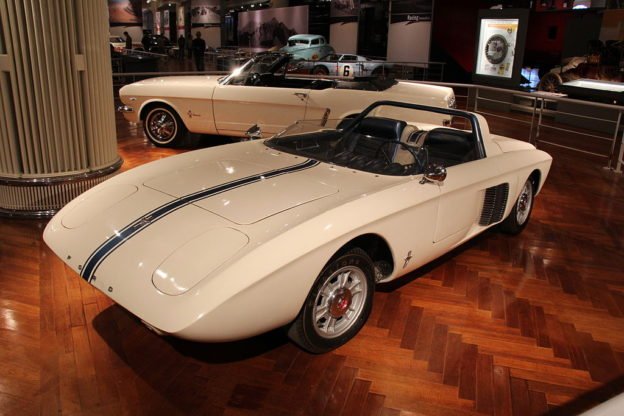
By Sicnag (1962 Ford Mustang I Roadster) [CC BY 2.0 (http://creativecommons.org/licenses/by/2.0)], via Wikimedia Commons
A Radical Departure
The 1962 Mustang I was nothing like the production Mustangs that would later revolutionize the automotive industry. This sleek, two-seater sports car featured:
- A mid-mounted 1.5-liter (1500cc) V4 engine
- Lightweight aluminum body construction
- Open-top roadster configuration
- Advanced aerodynamic design
- Racing-inspired cockpit
- The first appearance of the iconic galloping pony emblem
Technical Innovation
Ford’s engineering team, led by Roy Lunn, created a vehicle that was as technically advanced as it was beautiful. The V4 engine, borrowed from Ford’s European division, could be tuned to produce up to 100 horsepower and reach speeds of 120 mph – impressive figures for such a small displacement engine in 1962.
What made Lunn’s approach genuinely radical was the decision to place that engine behind the driver rather than under a front hood. American automakers simply did not do this. In 1962, mid-engine layouts belonged to European racing machines and exotic sports cars that most Americans would never see outside a magazine.
By choosing that configuration, Ford was making a statement about who they wanted to be — not just a maker of family sedans, but a company that understood performance at a fundamental level. The aluminum body reinforced that message. Steel was cheaper and easier to work with, but aluminum saved weight, and weight was the enemy of everything the Mustang I was meant to represent.

By Own work by William “Bill” Zuk [Public domain], via Wikimedia Commons
Historic Debut
he Mustang I made its dramatic public debut on October 7, 1962, at the United States Grand Prix at Watkins Glen, New York. In a moment that would become part of Mustang lore, Formula One driver Dan Gurney drove demonstration laps in the prototype, reportedly achieving speeds matching those of the contemporary F1 cars on the straights.
The choice of venue was deliberate. Ford did not unveil the Mustang I at an auto show surrounded by carpet and spotlights. They brought it to a race track, in front of an audience that came specifically to watch the fastest cars in the world compete.
When Gurney pulled onto that circuit, the message was unmistakable: this was not a styling exercise.
The crowd response and the press attention that followed told Ford’s product team something important — the Mustang name had real power, and the public appetite for a sporty, affordable American car was larger than anyone had formally measured.
The Mustang Design Decision That Changed Everything
The Mustang I’s Watkins Glen debut had done its job almost too well. Public and press reaction was enthusiastic, but Ford’s market research was pointing somewhere the concept car couldn’t follow. The two-seat, mid-engine roadster appealed to enthusiasts, but enthusiasts alone would never generate the sales volume Ford needed to justify production.
It was Lee Iacocca, then Ford’s general manager, who pushed the project toward what it eventually became. Iacocca understood that the car needed to seat four, cost under $2,500, and appeal to the young buyers who were just entering the market in massive numbers as the baby boom generation came of age. The mid-engine layout, the aluminum body, the racing-derived mechanicals — all of it had to go.
What replaced it was the 1963 Mustang II show car, a much more conventional front-engine design that pointed directly toward the production 1964½ model. The Mustang I had started the conversation. Iacocca’s team decided where it would end.
Legacy Elements
While the production Mustang would take a very different form, several design elements from the 1962 concept car influenced the entire Mustang lineage:
- The galloping pony emblem
- The long hood/short deck proportions
- The aggressive stance
- The driver-focused cockpit design
The Surviving Prototype

Only two examples of the Mustang I were ever constructed:
- A non-running show car for static displays
- A fully functional prototype for testing and demonstrations
The functional prototype was rediscovered in 1967 and underwent careful restoration. In 1982, it found its permanent home at the Henry Ford Museum in Dearborn, Michigan, where it sits alongside the first production 1964½ Mustang – a Wimbledon White convertible with a 260-V8 engine.
Historical Significance
The 1962 Mustang I represents a crucial moment in automotive history. While its radical mid-engine design never reached production, the concept car served several vital purposes:
- It tested public reaction to the Mustang name and brand
- It demonstrated Ford’s technical capabilities
- It generated excitement among the automotive press
- It helped establish design elements that would influence multiple generations of production Mustangs
See It Today
Visitors to the Henry Ford Museum can view this historic prototype alongside other significant Mustangs, offering a unique opportunity to see where the Mustang story began. The contrast between the experimental 1962 concept and the first production 1964½ model provides fascinating insights into Ford’s development process and the evolution of one of America’s most beloved automotive icons.
The Mustang Legacy Lives On
The 1962 Mustang I never reached a showroom, but its influence never really left. Every Mustang built since 1964 carries something of what Roy Lunn and his team were reaching for at Watkins Glen — the idea that an American car could be genuinely exciting, not just fast in a straight line. For collectors and enthusiasts today, that lineage is a big part of what makes early Mustangs some of the most sought-after classic cars on the market.
If you’re researching vintage Mustangs — whether you’re tracking the history, considering a purchase, or just deep in the rabbit hole the way most of us get — Classic Cars Online US covers the full Mustang story from concept to collector. Browse our Mustang articles for specs, history, and buying guidance across the entire model range.
And, join the conversation with fellow enthusiasts on Facebook at our Facebook page, the Best Classic Cars for Sale Online Facebook page or the Classic Cars Online: Classic Cars for Sale Facebook group.
By: Laure Justice