
Originally published April 10, 2016 | Updated November 5, 2026

Removing old paint, rust, body filler, and years of accumulated grime is often one of the first major steps in a classic car restoration. But how should you strip the body before moving on to repairs and refinishing?
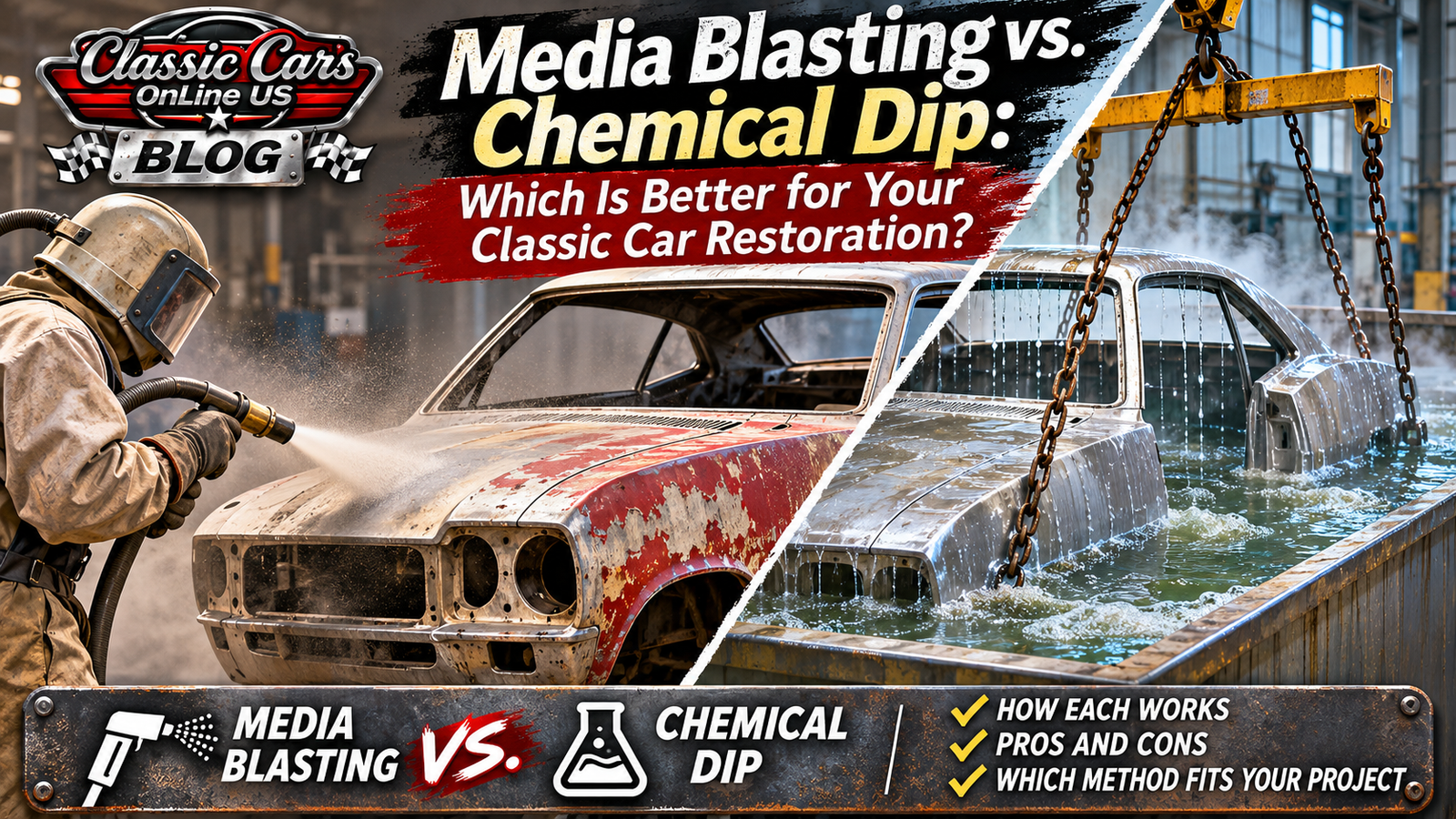
Two popular professional options are media blasting and chemical immersion dipping. Both can remove unwanted coatings and expose areas that need attention, but they work differently and have their own advantages and limitations.
Choosing between them depends on the vehicle’s condition, the amount of corrosion, the type of material being removed, and the restoration work you plan to do next.
Let’s look at how each process works and what you should consider before making a decision.
What Is Media Blasting?
Media blasting uses compressed air to propel an abrasive or cleaning material against a vehicle’s surface. The impact removes paint, rust, undercoating, and other unwanted materials.
The type of blasting media makes a significant difference. Different materials have different levels of abrasiveness, and not every option is appropriate for every part of a classic car.
Common media choices include:
- Sand: An aggressive abrasive that can remove stubborn coatings and rust. However, it can damage thin automotive sheet metal, create excessive heat, and present serious inhalation hazards. Silica-containing blasting sand should not be treated as a harmless or routine DIY option.
- Glass beads: Often used for cleaning metal components and producing a smoother finish. They are not automatically safe for thin body panels, since pressure, technique, and heat buildup still matter.
- Walnut shells: A softer media that can remove paint and coatings without the aggressive cutting action of harder abrasives. It is less effective against heavy rust.
- Soda: A relatively gentle option for removing paint and certain contaminants. It does not remove established rust effectively, and the residue must be thoroughly cleaned before refinishing.
- Plastic media: Used for paint and coating removal where a less aggressive approach is desirable. It generally does not remove rust.
The right media, equipment settings, and operator experience all matter. A method that works well on a heavy steel component may be too aggressive for a thin body panel.
Advantages of Media Blasting
Media blasting can be an effective way to remove old coatings and expose areas that need repair.
Some advantages include:
- Versatility: Different media types can be selected for different materials and conditions.
- Visibility: Removing paint and surface buildup can reveal rust, dents, previous repairs, and other problems.
- Selective treatment: A shop can focus on specific panels or components rather than treating the entire vehicle.
- No chemical immersion: The vehicle does not have to be submerged in a stripping solution.
For many restoration projects, media blasting provides a practical way to clean individual parts or prepare selected areas for repair.
Disadvantages of Media Blasting
Media blasting is not without risks.
Thin automotive sheet metal can warp when excessive heat builds up during blasting. Aggressive media, high pressure, or holding the nozzle in one area too long can contribute to the problem.
Blasting media can also become trapped in seams, enclosed areas, body cavities, and other hard-to-reach locations. Any remaining material must be removed before repairs and refinishing.
The process may also fail to reach corrosion inside enclosed sections of the vehicle. A clean-looking exterior does not necessarily mean the entire structure is rust-free.
Media blasting is best handled by an experienced operator who understands the differences between media types and knows how to work with older automotive sheet metal.
What Is Chemical Dipping?
Chemical dipping, also called chemical immersion stripping, involves placing a disassembled vehicle body or individual components into a chemical bath.
Depending on the process, the chemicals may remove paint, undercoating, body filler, rust, and other unwanted materials. Different facilities use different chemical systems, including acidic, alkaline, and multistage processes.
Chemical immersion is not the same as applying a brush-on paint stripper to a panel. A professional dipping facility uses a controlled process intended for automotive parts and bodies.
The vehicle must be extensively disassembled before dipping. Glass, wiring, upholstery, rubber components, trim, and other materials that are not compatible with the chemical process must be removed.
Advantages of Chemical Dipping
Chemical immersion can offer several benefits for a restoration project.
- Access to complicated areas: A properly designed process can reach many areas that are difficult to access with blasting equipment.
- Removal of multiple coatings: Depending on the chemicals used, dipping can remove paint, filler, undercoating, and corrosion products.
- No abrasive impact: Chemical stripping does not rely on blasting media striking the metal, so it avoids the direct impact and heat-related panel damage associated with improper blasting.
- Detailed inspection: Once the body is stripped and the process is complete, previously covered areas may be easier to inspect.
For a vehicle with multiple layers of old paint, filler, and corrosion, chemical dipping may be worth considering.
Disadvantages of Chemical Dipping
Chemical dipping also has limitations.
The process requires extensive disassembly, which adds labor and preparation costs. Not every vehicle is a good candidate, and the condition of the body should be evaluated before it goes to a dipping facility.
Chemical treatment is also process-dependent. Different facilities use different solutions and procedures, and not every process removes every type of material or treats every enclosed area equally.
Another concern is chemical residue. If the body is not properly rinsed, neutralized when required, and dried, residue can remain in seams or cavities and contribute to future corrosion or paint problems.
A reputable facility should be able to explain its cleaning, rinsing, neutralizing, and drying procedures. Ask how it treats enclosed sections and how it prepares the metal for the next stage of restoration.
Chemical dipping avoids abrasive impact, but that does not mean it is risk-free or automatically produces a perfect surface.
Media Blasting vs. Chemical Dipping: How Do They Compare?
Both methods can be useful, but they are not interchangeable. The best choice depends on the vehicle, the materials being removed, and the quality of the facility performing the work.
| Consideration | Media Blasting | Chemical Dipping |
|---|---|---|
| How it works | Compressed air propels selected media against the surface | Vehicle body or components are immersed in a chemical solution |
| Paint removal | Effective with appropriate media | Effective, depending on the chemical process |
| Rust removal | Can remove accessible rust, depending on media and technique | Can treat corrosion in accessible immersed areas, depending on the process |
| Thin sheet metal | Risk of warping if media, pressure, or technique is unsuitable | Avoids abrasive impact, but still requires careful handling and processing |
| Enclosed areas | Media may not reach every cavity and can become trapped | May reach many cavities, but coverage and residue removal depend on the process |
| Vehicle preparation | Components may be blasted individually or as part of a larger project | Extensive disassembly is generally required |
| Cleanup | Blasting media must be completely removed | Rinsing, neutralizing when required, and thorough drying are essential |
| Cost | Varies with vehicle size, media, and labor | Varies with vehicle size, process, disassembly, and facility |
| Best use | Selected panels, components, and accessible surfaces | Projects that benefit from comprehensive chemical stripping |
Neither method guarantees that every bit of corrosion or contamination will be removed. A thorough inspection after stripping is still necessary.
Which Method Is Better for Your Classic Car?
There is no universal winner. The condition of the vehicle and the type of restoration you are planning should guide the decision.
When Media Blasting Makes Sense
Media blasting may be the better choice when:
- You need to strip selected panels or individual components.
- The vehicle has accessible rust and old coatings that can be removed with an appropriate media.
- You want to avoid the expense and extensive disassembly required for chemical immersion.
- You have access to a shop experienced in working with older automotive sheet metal.
The shop should be able to explain which media it plans to use and why. Ask how it protects thin panels, controls pressure, and removes media from seams and cavities.
When Chemical Dipping Makes Sense
Chemical dipping may be worth considering when:
- The vehicle has multiple layers of paint, filler, or undercoating.
- You want a process that can reach many areas that are difficult to access with blasting equipment.
- The body can be completely disassembled.
- A reputable facility can explain its chemical process and how it handles rinsing, neutralization, drying, and corrosion protection.
Before committing, ask the facility what its process removes, what it does not remove, and how it handles enclosed areas.
What About Combining the Two Methods?
Some restoration projects benefit from using different methods for different components.
For example, a shop might use chemical immersion for a body shell and media blasting for selected components. Another project may need only localized blasting and conventional cleaning.
The goal is not to choose the most aggressive stripping method. It is to remove unwanted materials while preserving as much sound original metal as possible.
What Happens After the Car Is Stripped?
Stripping the vehicle is only the beginning. Once the old paint, coatings, and corrosion have been removed, the body needs a careful inspection.
Look for:
- Rust holes and perforated metal
- Weak or damaged structural areas
- Previous repairs hidden beneath filler
- Cracks, dents, and damaged seams
- Corrosion around panels, joints, and enclosed areas
- Any remaining blasting media or chemical residue
Rust damage may require cutting out affected metal and welding in properly fitted replacement sections. Body filler is intended for cosmetic finishing, not for replacing weakened or missing structural metal.
The surface also needs to be properly cleaned, prepared, and dried before applying a protective coating. Bare steel can begin to develop surface rust when exposed to moisture, so follow the stripping facility’s recommendations and the coating manufacturer’s instructions for the next steps.
Choosing an Epoxy Primer
A quality automotive epoxy primer designed for direct-to-metal application can provide an important protective foundation before additional bodywork and paint.
One option to consider is the Kirker Enduro Prime DTM Epoxy Primer, Gray, 1 Quart.
Paid link: I may earn a commission if you make a purchase through this Walmart link.
This product is an option for properly prepared restoration surfaces. Check whether the required catalyst is included or must be purchased separately. Use the primer only on compatible surfaces and according to the manufacturer’s directions, including its requirements for surface preparation, mixing, application, safety equipment, and compatible topcoats. Product suitability and application requirements should always be confirmed using the current technical data sheet.
Make the Right Choice Before You Strip
Media blasting and chemical dipping can both play important roles in classic car restoration. Each has advantages, and each requires careful handling to avoid creating additional problems.
Media blasting offers flexibility and can be useful for individual panels and components. Chemical dipping can reach many areas that are difficult to access with blasting equipment, but it requires extensive disassembly and a reliable cleaning and corrosion-prevention process.
Before choosing either method, talk with experienced restoration professionals, ask questions about their procedures, and make sure you understand what happens after the stripping process is complete.
The right approach is the one that removes unwanted coatings and corrosion while preserving the vehicle’s original metal and preparing it for the next stage of restoration.
Have you used media blasting or chemical dipping on a classic car project? Share your experience in the comments. Your insights may help another enthusiast decide how to approach a restoration.
You can also follow Classic Cars Online US for more classic car history, restoration advice, project ideas, and automotive stories.
Visit Classic Cars Online US on YouTube
Join the Classic Cars Online US Facebook community
Affiliate Disclosure: Classic Cars Online US participates in affiliate marketing programs. We may earn a commission when you purchase products through qualifying links, at no additional cost to you. As a Walmart affiliate partner, we may earn a commission from qualifying purchases made through Walmart links. This helps support the website and its automotive content.
If you would like to connect on social media, be sure to visit and like this site’s Facebook page, the Best Classic Cars for Sale Online Facebook page or join the Classic Cars Online: Classic Cars for Sale Facebook group.